Your AI Is Accurate. But Is It Fair, Ethical, or Even Trustworthy?
Your AI Is Accurate. But Is It Fair, Ethical, or Even Trustworthy? Why building responsible AI requires more than high accuracy, sophisticated algorithms, and good intentions. Imagine two candidates applying for the s

Your AI Is Accurate. But Is It Fair, Ethical, or Even Trustworthy?
Why building responsible AI requires more than high accuracy, sophisticated algorithms, and good intentions.
Imagine two candidates applying for the same job.
Both have relevant qualifications, strong experience, and similar skills. An AI-powered recruitment system evaluates their applications and recommends one candidate while rejecting the other.
The organisation reports that its model achieves 95% accuracy.
Sounds impressive, right?
But what if that same system consistently makes more mistakes when evaluating candidates from certain demographic groups?
What if applicants never discover why they were rejected?
And what if nobody can meaningfully challenge the decision?
Suddenly, 95% accuracy doesn't tell us nearly enough.
This is one of the most important questions in AI development: when a system produces technically impressive results, does that automatically make it fair, ethical, or trustworthy?
Not necessarily.
Through my studies in AI & Data Ethics as part of my MSc in Applied Artificial Intelligence at Northeastern University London, I've been exploring how these questions connect to real-world AI systems.
The most interesting lesson is that AI ethics isn't simply about making algorithms better. It's about understanding what makes their use justified, who their decisions affect, and how those decisions should be governed.
Let's explore some assumptions that deserve closer examination.
1. Can an AI System Be Accurate and Still Be Unfair?
Absolutely. And this is where evaluating AI becomes more complicated than checking a single performance metric.
Imagine an AI system used to assess the risk of loan defaults. It achieves the same overall accuracy for two demographic groups.
At first glance, the system might appear equally effective for everyone.
But suppose its mistakes are distributed differently:
- For Group A, it frequently rejects applicants who would actually repay their loans.
- For Group B, it more frequently approves applicants who subsequently default.
Even if overall accuracy is identical, the groups experience different types of errors and consequences.
A false rejection could deny someone access to housing, education, or a business opportunity. A false approval creates a different kind of financial risk.
The ethical question isn't only how often the AI is correct. It's also who bears the consequences when it is wrong.
A real-world example: COMPAS
The COMPAS risk-assessment system became a prominent example in discussions about algorithmic fairness.
In 2016, ProPublica examined the system's predictions about the likelihood of defendants being arrested again.
Its analysis reported racial differences in the types of errors made. Black defendants were more likely to be incorrectly classified as higher risk, while white defendants were more likely to be incorrectly classified as lower risk.
The company behind COMPAS disputed ProPublica's analysis and defended the system using a different interpretation of predictive fairness.
The disagreement highlights something important: different fairness criteria can lead to different conclusions about the same model.
An AI system can perform similarly across groups under one measure and differently under another.
Fairness is more than a metric
In Getting from Commitment to Content in AI and Data Ethics: Justice and Explainability, John Basl, Ronald Sandler, and Steven Tiell discuss why broad commitments to justice need more precise meaning before they can guide AI development.
Three useful perspectives are:
Procedural justice: Is the decision-making process fair, consistent, and open to appropriate review?
Distributive justice: Are benefits, opportunities, risks, and burdens distributed fairly?
Recognition justice: Are affected individuals and communities properly recognised, respected, and represented?
These perspectives help explain why optimising a fairness metric is not the same thing as resolving every fairness concern.
An AI hiring system, for example, might satisfy a statistical criterion while still relying on an unjustified process or making decisions that applicants cannot challenge.
The lesson for developers is straightforward:
Before asking which fairness metric to optimise, ask what fairness should mean in the particular system you're building.
2. If an AI Explains Its Decision, Does That Make It Trustworthy?
Suppose an AI system rejects a loan application.
The applicant asks why.
The system responds:
"Your application was rejected because of your credit history, income stability, and debt-to-income ratio."
That sounds transparent.
But does the explanation establish that the decision was justified?
Not necessarily.
Perhaps the underlying data was inaccurate. Perhaps an inappropriate variable influenced the prediction. Perhaps the applicant has no way to correct an error.
This brings us to four related but distinct concepts.
Transparency concerns what information about the system and its operation is made available.
Explainability concerns whether understandable reasons or accounts can be provided for a system's behaviour.
Interpretability concerns how people can make sense of a model's operation or outputs.
Accountability concerns who must answer for decisions, address failures, and provide appropriate remedies.
These concepts are connected, but they aren't interchangeable.
A system may disclose technical details without offering an explanation that a person can understand.
It may provide a convincing explanation without showing whether the underlying decision was justified.
And it may have detailed records of every decision while lacking a meaningful process for challenging mistakes.
This is closely connected to Basl, Sandler, and Tiell's argument that ethical principles need context-specific requirements.
Simply promising transparency is insufficient.
We should ask:
- Transparent to whom?
- About which information?
- For what purpose?
- What can an affected person actually do with that information?
Consider the difference between giving someone a technical explanation and giving them a genuine opportunity to challenge an incorrect outcome.
The second requires more than a well-written explanation. It may require access to relevant information, a review process, and someone with the authority to correct the decision.
Transparency can help enable accountability, but transparency alone does not guarantee it.
3. If You Agree to Data Collection, Is Your Privacy Protected?
We've all clicked "Accept" on privacy notices without reading every line.
But does clicking a button always mean we have made a meaningful, informed choice?
Imagine an AI personal assistant that manages your calendar.
To schedule a meeting, it requests access to your calendar, email, contacts, and documents.
Some of that information may be useful for completing the task.
But should the assistant automatically have permission to access every message, retain unrelated information, or share another person's contact details?
This reveals a key distinction:
Authorising an AI system to complete a task is not the same as giving it unrestricted authority over personal data.
Privacy is more than keeping information secret
Privacy also involves autonomy, control, context, and exposure to potential harm.
A service might securely store information while collecting substantially more than it needs.
A person might agree to data processing without having a meaningful alternative.
And data shared for one legitimate purpose might later be reused in ways that the person did not reasonably expect.
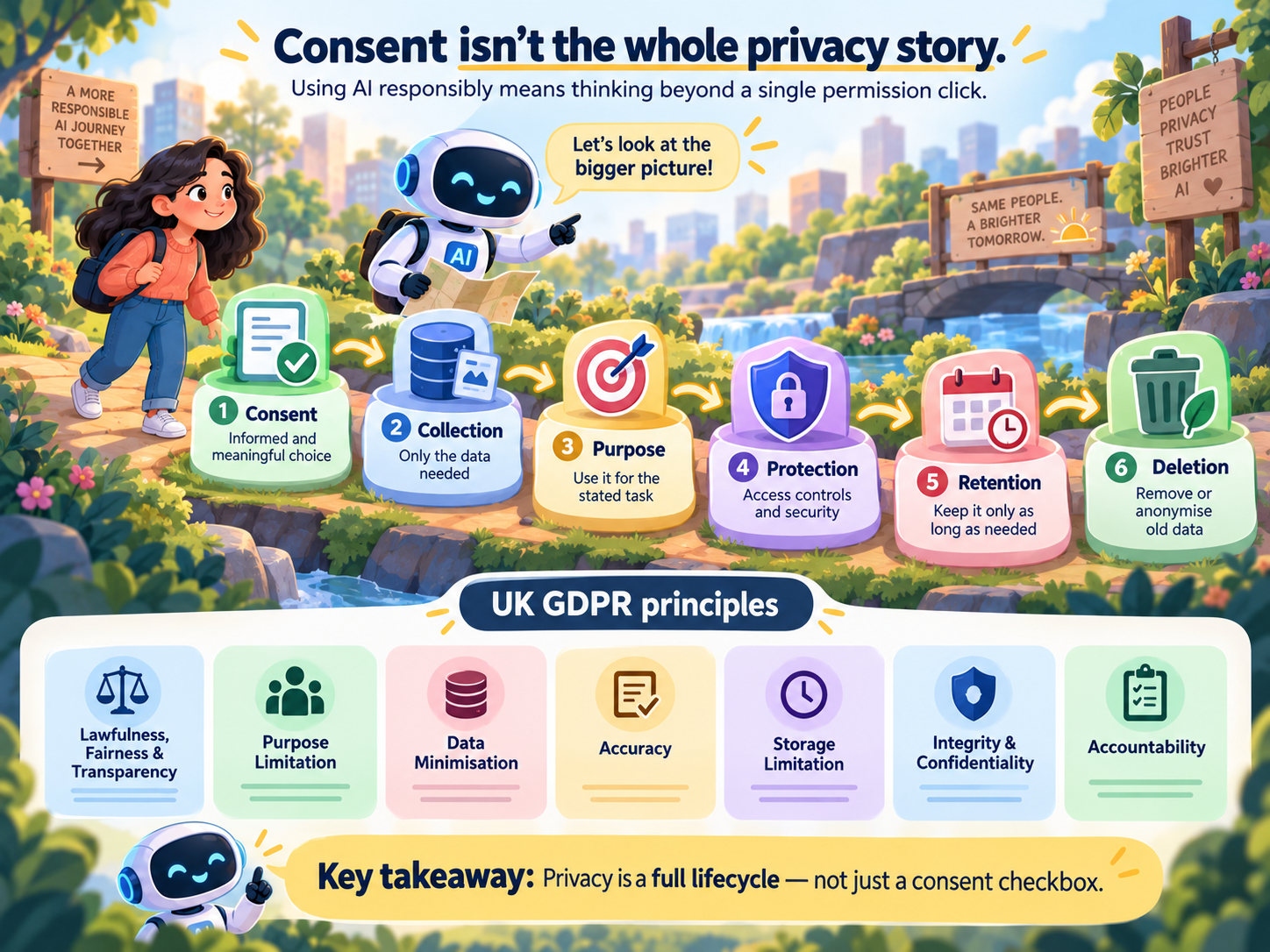
This is why privacy cannot be reduced to either encryption or a consent checkbox.
The seven UK GDPR principles
The UK General Data Protection Regulation provides an important foundation for thinking about responsible personal-data processing.
Its seven principles are:
- Lawfulness, fairness, and transparency: Process personal data lawfully and fairly, with appropriate transparency.
- Purpose limitation: Collect data for specified, legitimate purposes and respect restrictions on further use.
- Data minimisation: Collect only data that is necessary for the relevant purpose.
- Accuracy: Keep personal data accurate and appropriately updated.
- Storage limitation: Avoid retaining identifiable personal data longer than necessary.
- Integrity and confidentiality: Protect information using appropriate security measures.
- Accountability: Take responsibility for complying with data protection requirements and demonstrate that compliance.
These principles are relevant when developing AI systems that access, process, store, or share personal information.
One important legal distinction: consent is not the only lawful basis for processing personal data under the UK GDPR.
The broader principle is that processing must have an appropriate lawful basis and comply with the applicable requirements.
For developers, a useful question is not simply:
"Can my AI system access this data?"
It is:
"Does this system need the data, is its use justified, and what controls protect the people concerned?"
](https://media2.dev.to/dynamic/image/width=800%2Cheight=%2Cfit=scale-down%2Cgravity=auto%2Cformat=auto/https%3A%2F%2Fdev-to-uploads.s3.us-east-2.amazonaws.com%2Fuploads%2Farticles%2F5qc4khtqb3wyluoqn3jr.png)
4. Are Algorithms Showing Us What We Want, or Shaping What We Believe?
Consider how you consume information online.
You open a social platform and encounter a stream of posts, articles, recommendations, and opinions.
You might assume that what you see mainly reflects your interests.
But the information you encounter is also influenced by the platform's ranking systems, recommendation objectives, and the behaviour of other users.
That matters because the information we encounter can influence the beliefs and decisions we form.
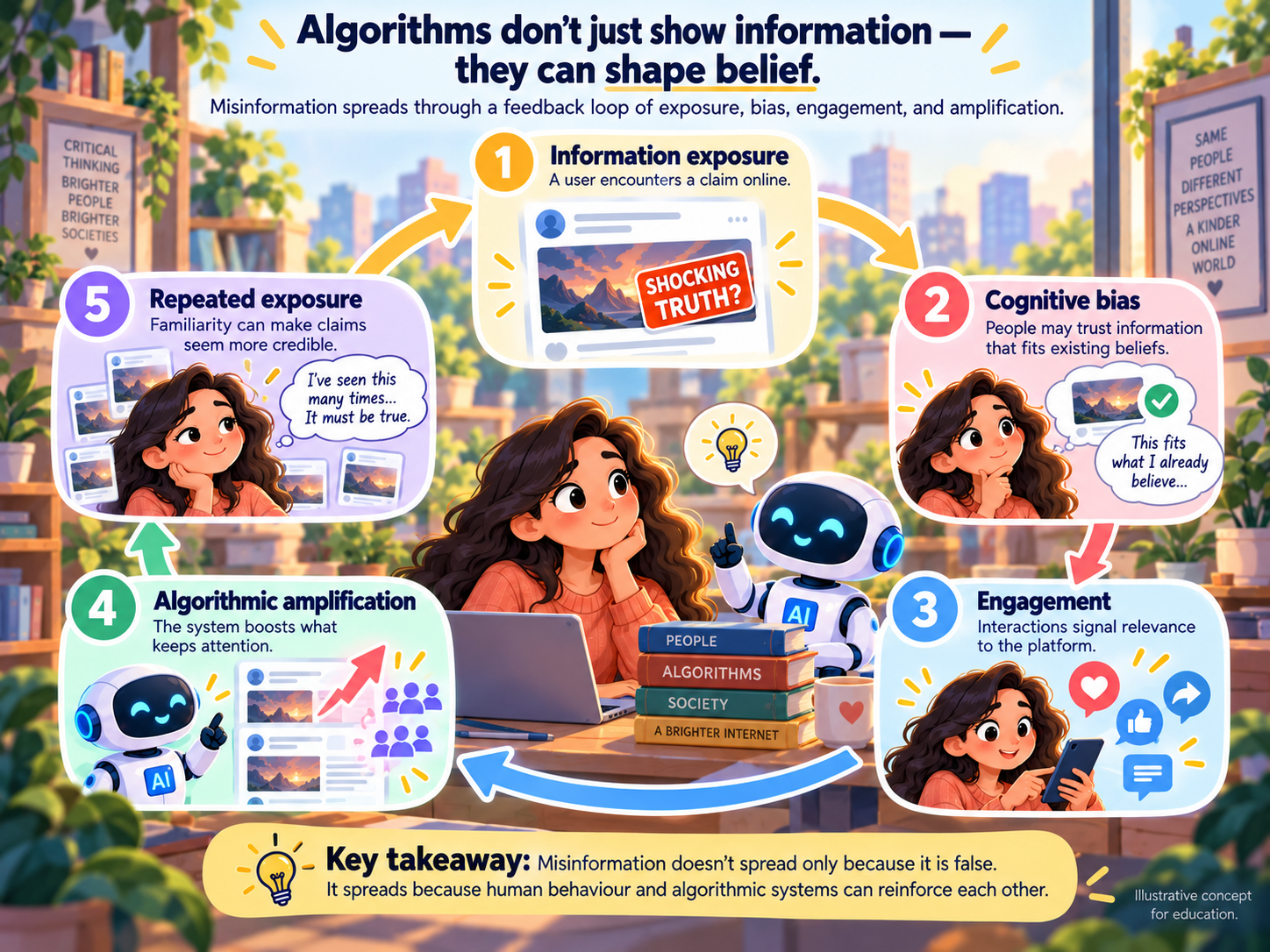
Why misinformation spreads
In Information Overload Helps Fake News Spread, and Social Media Knows It, Filippo Menczer and Thomas Hills examine how information overload, cognitive biases, social influence, and algorithmic amplification contribute to misinformation.
Several mechanisms are especially interesting.
Information overload: People cannot carefully evaluate every piece of information they encounter.
Confirmation bias: We may be more receptive to information that supports beliefs we already hold.
In-group influence: Information shared by people we identify with may seem more credible.
Algorithmic amplification: Ranking and recommendation systems can increase the visibility of particular content, including misleading material.
Social bots: Automated accounts can contribute to the appearance and spread of online social activity.
These mechanisms can interact.
Imagine someone encounters a misleading claim, engages with it, receives more related content, and repeatedly encounters similar messages from trusted contacts.
Over time, the repeated exposure may reinforce existing beliefs.
Importantly, this is a possible feedback mechanism, not an inevitable outcome for every user.
](https://media2.dev.to/dynamic/image/width=800%2Cheight=%2Cfit=scale-down%2Cgravity=auto%2Cformat=auto/https%3A%2F%2Fdev-to-uploads.s3.us-east-2.amazonaws.com%2Fuploads%2Farticles%2Fwpmlv2axjvtzrvihefd1.png)
When does personalisation become manipulation?
This question becomes even more interesting when considered alongside Will Democracy Survive Big Data and Artificial Intelligence? by Dirk Helbing and colleagues.
Their discussion examines how large-scale data collection, behavioural prediction, and automated influence can affect individual autonomy and democratic decision-making.
Personalisation can be useful.
It can help people discover relevant information, reduce unnecessary searching, and navigate large amounts of content.
But it can also create opportunities to steer behaviour.
The ethical distinction involves more than whether a recommendation is personalised.
We should consider whether people understand how they are being influenced, whether relevant alternatives are concealed, and whether systems exploit vulnerabilities rather than support informed choices.
A recommendation system doesn't need to issue an explicit instruction to influence a decision.
Sometimes, changing which options a person sees is enough to change the decision they eventually make.
This is why responsible AI includes attention to the wider information environment, not just the predictive accuracy of individual models.
5. When AI Causes Harm, Who Is Responsible?
Suppose an organisation deploys an AI system that automatically evaluates customer requests.
One day, it rejects an eligible customer because of incorrect data.
The developer says the model produced its expected output.
The organisation says the system made the decision automatically.
The customer receives an explanation but cannot find anyone authorised to correct the mistake.
So who is responsible?
This illustrates the difference between identifying a technical failure and establishing accountability.
A technical investigation might determine that the problem originated in the input data, model predictions, decision rules, or integration with another system.
But identifying the cause doesn't automatically tell us who had a duty to prevent the harm or who must correct it.
Responsibility cannot simply disappear into automation
Developers, deploying organisations, managers, and users may have different responsibilities depending on the system and context.
For example:
- Developers may be responsible for implementing agreed technical requirements, testing behaviour, and communicating limitations.
- Deploying organisations may be responsible for deciding whether the system is appropriate for its intended use, establishing oversight, and handling complaints.
- Authorised human operators may have responsibilities relating to review, intervention, and escalation.
The exact allocation depends on the circumstances, contractual relationships, governance arrangements, and applicable law.
What about AI agents?
This question becomes especially relevant when AI systems do more than generate predictions.
An AI agent might retrieve information, select tools, interact with external services, and carry out several steps toward a goal.
An agent may successfully complete an authorised task while taking an unnecessary or inappropriate action along the way.
For example, consider an assistant asked to arrange a meeting. It successfully schedules the appointment but also discloses confidential information from an unrelated document.
The final task appears completed.
But the overall behaviour is not acceptable.
This connects AI ethics with practical engineering decisions, including tool permissions, access restrictions, human approvals, execution records, and mechanisms for stopping or correcting actions.
A system may have a human approval button and still provide ineffective oversight if the reviewer lacks sufficient information or authority.
Meaningful human oversight requires the ability to understand, intervene, challenge, and correct decisions where appropriate.
6. Can Ethical Principles Actually Become Engineering Requirements?
Many AI organisations describe their systems using familiar commitments:
Fairness. Transparency. Privacy. Accountability. Safety.
These are worthwhile goals.
But saying that a system is committed to fairness does not tell engineers which outcomes should count as unfair.
Promising privacy does not specify what data should be collected, retained, or deleted.
And declaring accountability does not establish who will investigate incidents or provide remedies.
This is the central challenge raised in Basl, Sandler, and Tiell's work: moving from broad ethical commitments to meaningful, context-specific requirements.
In other words, AI ethics needs to influence what gets built, tested, deployed, and governed.
From values to practical safeguards
Consider an AI recruitment system.
| Ethical concern | Practical question | Possible response |
|---|---|---|
| Fairness | Are errors distributed unjustifiably across applicant groups? | Evaluate relevant group-level performance and review outcomes |
| Privacy | Is unnecessary personal information being collected? | Apply data minimisation and access restrictions |
| Transparency | Can applicants understand relevant aspects of the decision? | Provide accessible explanations and appropriate information |
| Accountability | Who can investigate and correct a rejection? | Define review, escalation, and appeal procedures |
| Autonomy | Is meaningful human judgment preserved where needed? | Establish effective human review and intervention |
These examples are starting points, not universal solutions.
A fairness metric appropriate for one application might be unsuitable for another.
Greater transparency may need to be balanced against legitimate privacy and security concerns.
Collecting additional data might improve certain evaluations while creating new privacy risks.
And human review can become symbolic if reviewers merely approve automated recommendations without meaningful scrutiny.
Responsible AI therefore involves identifying trade-offs, making defensible decisions, and examining whether safeguards work as intended.
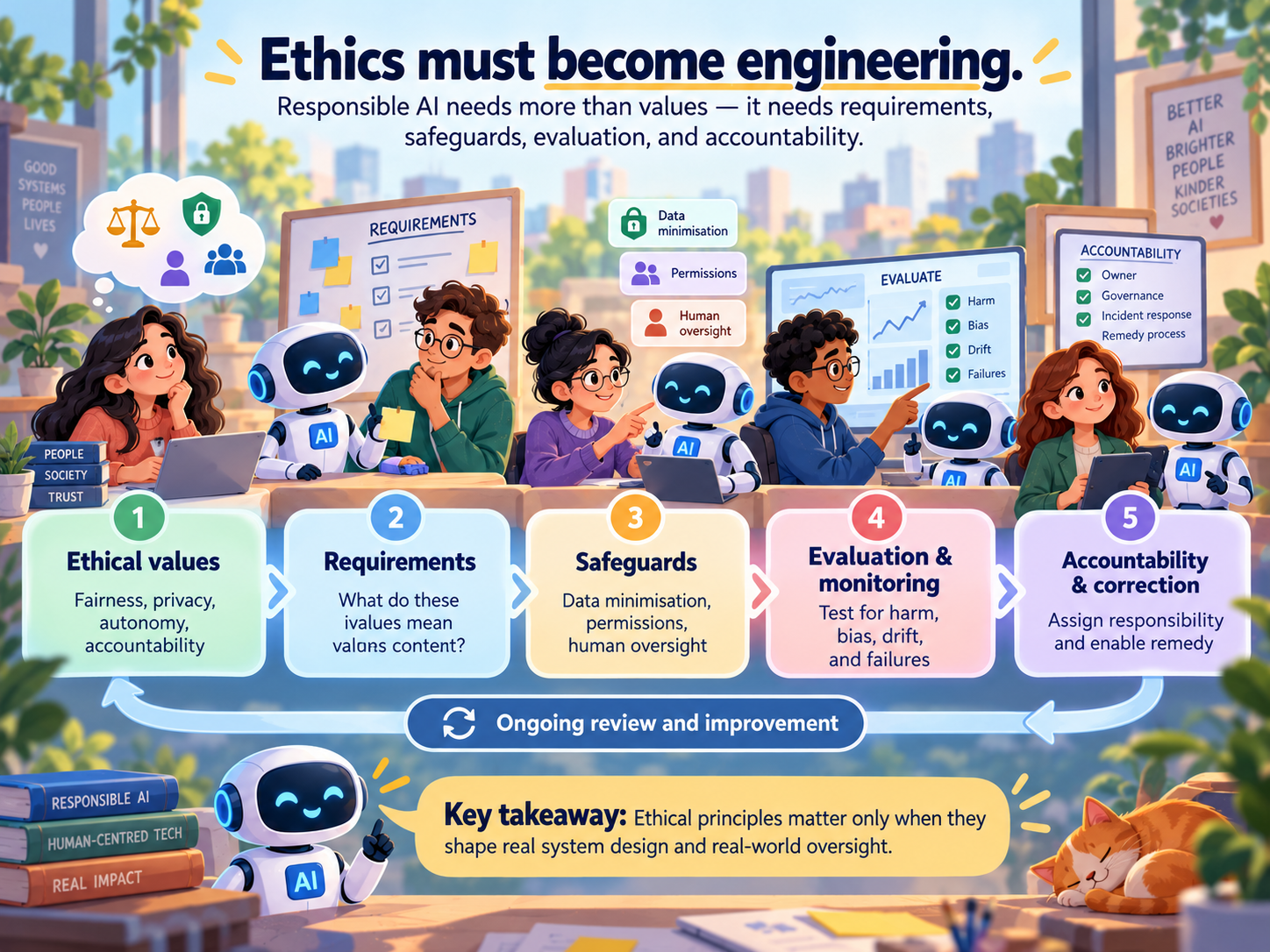
Ethics is not a final-stage checklist
A more useful approach is to integrate ethical reasoning throughout the AI system lifecycle.
Before development: Ask whether the intended use is justified, who will be affected, and what harms are foreseeable.
During design: Translate relevant values into specific requirements for data, model behaviour, permissions, explanations, and oversight.
During evaluation: Test not only aggregate performance but also relevant error patterns, limitations, and potential harms.
During deployment: Monitor behaviour, clarify responsibilities, and provide appropriate channels for intervention and correction.
After deployment: Reassess the system when its data, use, operating environment, or effects change.
](https://media2.dev.to/dynamic/image/width=800%2Cheight=%2Cfit=scale-down%2Cgravity=auto%2Cformat=auto/https%3A%2F%2Fdev-to-uploads.s3.us-east-2.amazonaws.com%2Fuploads%2Farticles%2Fw99r8ml0653w0hl3x20s.png)
This is also where the relationship between AI Ethics and AI Engineering becomes particularly important.
Ethical reasoning helps identify what ought to matter.
Engineering provides ways to implement, evaluate, and improve systems in response to those concerns.
Neither can replace the other.
7. So, What Makes an AI System Trustworthy?
Let's return to the recruitment system from the beginning.
It achieves 95% accuracy.
After exploring fairness, explainability, privacy, autonomy, and accountability, we can see why that statistic doesn't settle whether the system should be used.
We would still need to ask:
- Are the system's errors acceptable and fairly distributed?
- Was the data collected and processed appropriately?
- Can affected people understand and challenge consequential decisions?
- Does the system support meaningful human judgment?
- Are responsibilities for failures clearly established?
- Can the organisation monitor, correct, or discontinue the system when necessary?
These questions don't necessarily have simple or universally applicable answers.
That is precisely why ethical reasoning matters.
A trustworthy AI system is not defined by accuracy alone, nor by a checklist of ethical promises. Trustworthiness requires evidence that the system is appropriate for its purpose, that relevant risks are understood and managed, and that people remain able to hold its operators accountable.
For developers working in Applied AI, this changes how we think about building intelligent systems.
The objective is not merely to produce outputs that look correct.
It is to build systems whose decisions, limitations, and real-world consequences can be understood, evaluated, and responsibly managed.
The most important question may not be:
"How accurate is our AI?"
But rather:
"What makes this AI system worthy of the trust we're asking people to place in it?"
Further Reading
These sources informed the concepts and case studies discussed throughout this article.
John Basl, Ronald Sandler, and Steven Tiell (2021). Getting from Commitment to Content in AI and Data Ethics: Justice and Explainability. Atlantic Council.
Julia Angwin, Jeff Larson, Surya Mattu, and Lauren Kirchner (2016). Machine Bias. ProPublica. See also the methodology and response to criticism.
Filippo Menczer and Thomas Hills (2020). Information Overload Helps Fake News Spread, and Social Media Knows It. Scientific American.
Dirk Helbing and colleagues (2017). Will Democracy Survive Big Data and Artificial Intelligence?. Scientific American.
UK Information Commissioner's Office. A Guide to the Data Protection Principles.
This article is inspired by concepts explored during my MSc in Applied Artificial Intelligence at Northeastern University London, supported by academic readings, real-world case studies, and illustrative examples.
What do you think is the most overlooked aspect of trustworthy AI: fairness, privacy, explainability, autonomy, or accountability?
Originally published by Dev.to AI. Aggregated on AIWithGhost for educational purposes — full credit and traffic to the original publisher.