We have built our moving and storage CRM. Now we are adapting it for London.
Built around the whole customer journey A customer asks for a house move. During the call, they mention that the new property will not be ready for another six weeks. Some furniture needs storage. Other items need deli

Built around the whole customer journey
A customer asks for a house move. During the call, they mention that the new property will not be ready for another six weeks. Some furniture needs storage. Other items need delivering straight away. Suddenly, one enquiry involves a quote, a crew, a vehicle, warehouse space, recurring payments and a future return.
For the customer, it is one job: take care of their belongings. For the business, it is a sequence of decisions and handovers across several people.
My team at 3tf has completed the core build of a CRM designed around that sequence. The product is in its pilot stage, and we are now adapting and localising it for a company in London. The public BOXL project brings together the website, brand identity, CRM and training materials, so prospective partners can explore the approach before discussing their own implementation.
Explore the demo CRM · View the BOXL website · Explore the brand
Three years in the sector, from search demand to the next booking
Our work in moving and storage starts with understanding how customers look for help. Over three years, we have built practical experience of the language, offers and customer situations that bring enquiries in this sector.
A student looking for summer storage, a family moving home and a company relocating an office have different questions. Their deadlines, belongings, budgets and access requirements differ. The advertising and service page need to reflect the job each person wants done.
We know which phrases have brought enquiries in our work. For a new location, we research local demand and test the message again. We bring that experience into lead generation, landing pages and the information a team needs to collect after the first enquiry.
Advertising creates the opportunity. A clear follow-up process helps the company turn it into a booking. BOXL connects the stages: enquiry, assessment, quote, reservation, move or storage, billing and ongoing service.
Moving, storage or both — in one customer journey
The CRM starts with what the customer needs: storage, a move, or a move with storage. The enquiry can then follow the appropriate workflow without losing the customer's details.
The customer record brings together enquiries, quotes, storage rentals, items, invoices and recorded payments. This matters when someone comes back, rents a second unit, changes the amount of space they need or arranges delivery to another address.
For a move, the team needs to understand the addresses, floor, lift, parking and access conditions. Quotes and jobs sit alongside crews, vehicles and the calendar. For storage, the next steps include choosing suitable space, reserving it, preparing it and recording the move-in.
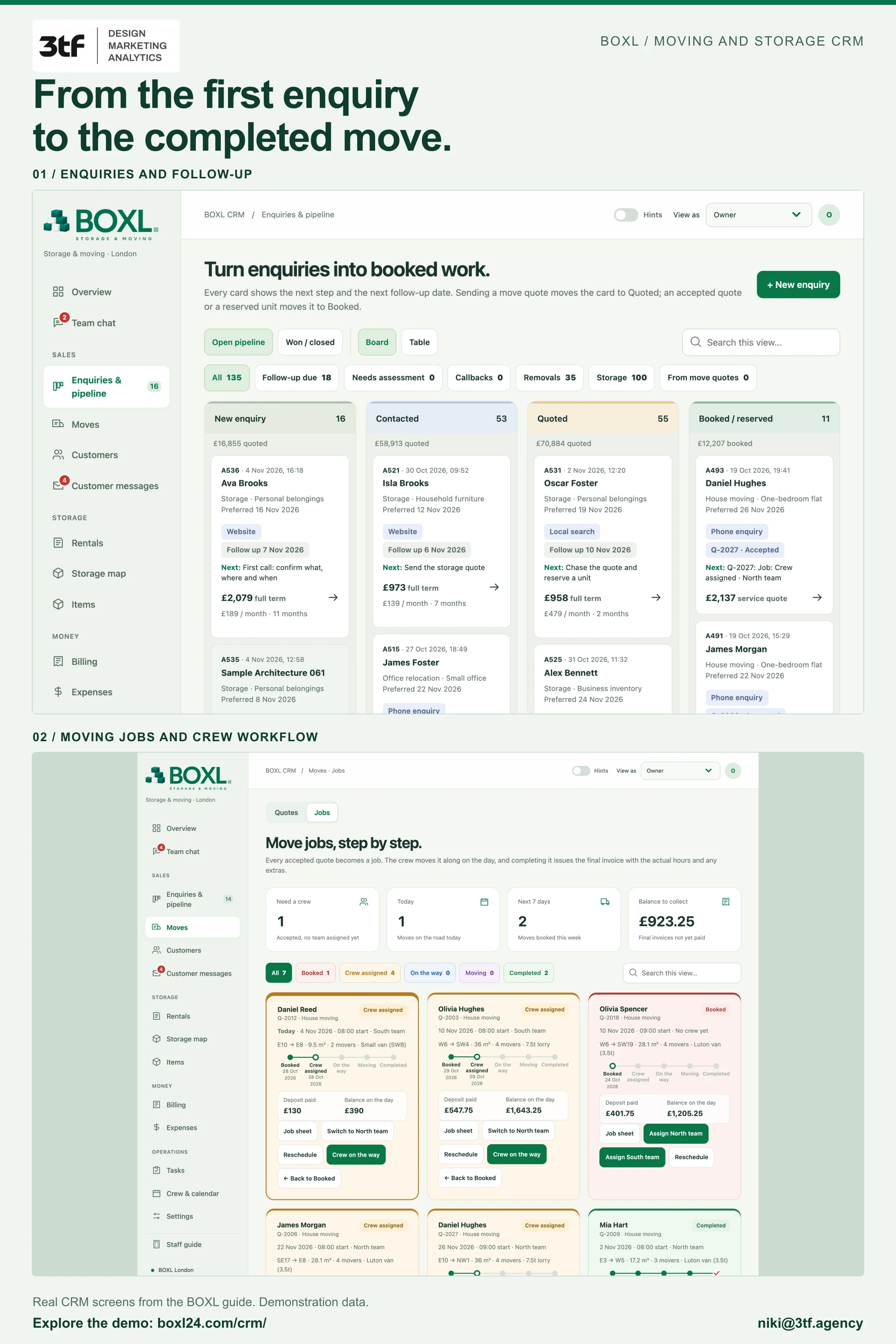
From enquiry follow-up to crew assignment and completed moves. Real screens from the BOXL guide; demonstration data. Select the collage to view it full size.
A website that helps customers explain the job
The BOXL website presents practical starting points: furniture storage, student storage, short stays, business storage, removals and moving with storage. A visitor can begin with their situation rather than needing to know the exact unit size.
The item planner lets someone list boxes, luggage and furniture and see an approximate volume. That list gives the office something useful to discuss during the callback. The London area selector adds local context before the team confirms the exact address and collection arrangements.
For each implementation, we agree how website enquiries reach the shared CRM and who owns the next action. The public demo illustrates the workflow using sample records.
Zones A, B and C: a warehouse your team can read
The storage map shows individual units grouped into zones. In the demo, these are A, B and C. Each unit has a code, dimensions and status. Colours distinguish available, occupied, reserved, preparing and out-of-order units.

Storage map from the BOXL staff guide. All records and operating figures shown are sample data.
The plan reflects the dimensions entered for the units. Managers can check what is available, warehouse staff can locate the right space, and the owner can review how capacity is being used.
The three zones are an example. We adapt the structure to the operator's actual facility, unit types and working arrangements. The model includes lockers, storage rooms, containers and drive-up units. We review specialist requirements before agreeing the implementation.
Bring your unit list from Excel or Google Sheets
The Import units function accepts a pasted table or a CSV file, with one row per unit. It supports unit codes, zones, width, depth, height, type, price and status. For space that is already let, the table can include the tenant, monthly rent and start date.
For example, a row for A-001 defines that unit's dimensions and tariff. Another row can describe B-001. A new zone is created when an imported row names one. The table can be checked before import.
This gives an operator a practical starting point using an existing inventory. The London version uses pounds and British measurements; currency, units and local conventions are part of the adaptation for another market.
Know which item is stored where
A unit number is useful, but a customer may ask for one particular box while leaving everything else in storage. The item inventory helps the team identify what belongs to whom, where it is located and what handling information needs to travel with it.

The item inventory connects belongings to their customer and storage location. This is a demonstration workspace.
Returns have their own workflow: request, confirmation, scheduling, picking, collection or delivery, and handover. The team can follow the return through its stages and record who received the items.
That detail matters for storage with collection and delivery, where customers rely on the operator to retrieve and return belongings on their behalf.
Recurring billing and auto-pay
Storage creates recurring obligations. Invoices need to be issued, payments recorded and outstanding balances followed up. The CRM includes recurring billing and auto-pay workflows, including repeat payment attempts and reminders.
This is the automatic recurring charge capability sometimes described as auto recharge. In a live implementation, we connect the agreed payment provider and configure the billing rules around the company's services and customer authorisations.
The public demo simulates card charges and customer messages. It does not charge real cards or send real emails or WhatsApp messages. It lets partners review the workflow before live integrations are connected.
The office can inspect invoices, partial payments, remaining balances and overdue accounts. Staff can see which records need attention and what has already been recorded.
Daily analytics at the top of the workspace
The Overview brings the main operating indicators together: unit occupancy, monthly rental value, available space and outstanding invoices. The Today tiles highlight work that needs attention.
The Trends section shows changes by day. It covers occupancy, move-ins, move-outs, money received, unpaid invoices, enquiries and moves. Users can select today, yesterday, seven days, 30 days, 90 days, the current year or a custom period, and compare against the previous period.
This helps an owner ask specific questions. Is occupancy increasing? Are outstanding invoices growing faster than collections? How has the number of enquiries changed? What is happening with move jobs?
The figures in the demo demonstrate the reporting behaviour; they are not results achieved for a live client. When marketing channels are connected, we also agree the tracking needed to relate enquiry sources to later outcomes.
Watch the Overview and business trends lesson.
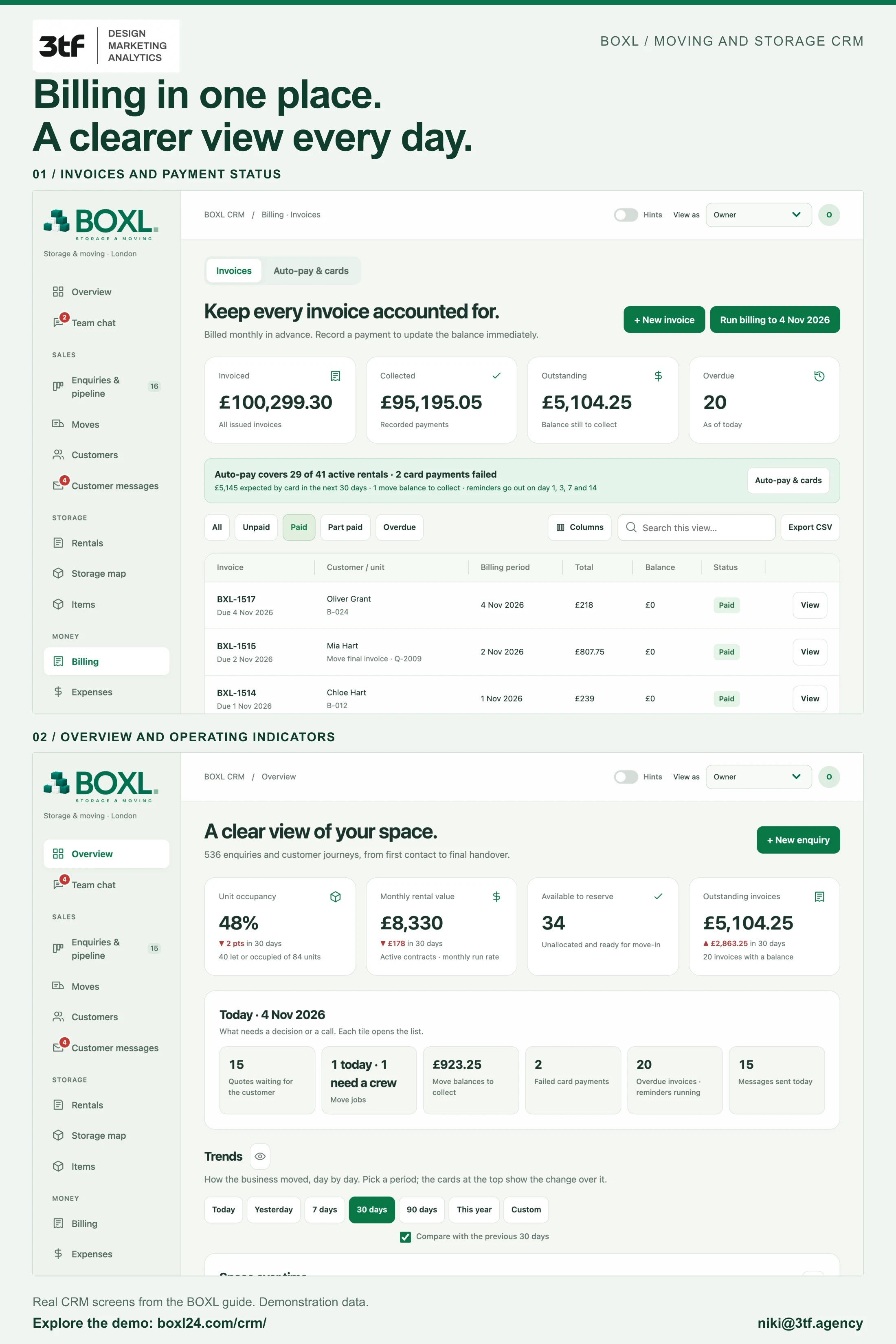
Billing and the Overview workspace, including daily period controls. All customer records and figures are demonstration data. Select the collage to view it full size.
A workspace for the office, warehouse, drivers and customers
The CRM includes role-based workflow previews, tasks, a crew calendar, team chat and activity history. Managers need enquiries and next actions. Warehouse staff need receiving and picking tasks. Drivers need the day's work and handover details. Owners need the wider operating picture.
The customer portal brings rental information, items, invoices and service requests together. Permissions and staff access are configured for the live implementation; the role switch in the public demo exists to show the different workflows.
WhatsApp automation, AI and voice guidance
Customer communication is part of the product's development. The CRM demonstrates messaging and WhatsApp workflows, with live communication services configured during implementation.
We are planning the next stage around automated WhatsApp replies that can handle routine questions, collect initial details and hand a conversation to a manager when it needs an individual quote or decision.
A useful first conversation might establish the area, intended date, item list and whether storage is needed. The aim is to help staff start with better information and respond consistently.
We are also exploring an AI assistant and voice guidance inside the CRM to help employees find the next action and understand unfamiliar tasks. These are planned capabilities, with scope and timing to be agreed and tested. They are not presented as already active in the public demo.
Localisation means understanding how the company works
Our current adaptation focuses on a company in London. That means working through service areas, address conventions, local terminology, prices, documents, responsibilities and customer expectations.
One business may focus on short-term storage. Another may run full house moves. A third may combine warehouse operations with regular collections and deliveries. We configure the journey around those differences.
We take the same approach in another country: review the market, understand the operation and agree what needs to change. A warehouse's layout, a team's responsibilities and a local service offer deserve more attention than a logo swap.
The brand, website and training are part of the project
BOXL includes a brand identity and brandbook covering the logo, colours, typography and applications. The website introduces the services, while the CRM demonstrates the work behind them. We can work with a partner's existing identity or develop the branding as part of the engagement.
Training matters just as much as the interface. The written staff guide explains the journey from enquiry to payment and day-to-day warehouse operations, with screenshots and downloadable PDFs.
The video gallery contains 49 short lessons, grouped for managers, warehouse staff and drivers, owners, and customers. A team member can open the task they need, from reserving a unit to handling a failed payment or reviewing the storage map.
We are inviting moving and storage companies worldwide
We are looking to work with self-storage operators, moving companies and businesses that combine collection, storage and return delivery.
We can help with a specific requirement — the CRM, the website or lead generation — or connect the whole customer journey. Our starting point is your business: the services you sell, the places you serve, the capacity you have and the work your team needs to manage.
Tell us your country, city and business model. We will show you the system and discuss what it would take to adapt it for your company.
Email [email protected] · Discuss it on WhatsApp
Explore the project
Originally published by Dev.to WebDev. Aggregated on AIWithGhost for educational purposes — full credit and traffic to the original publisher.