Vendor data breach exposes Chase, Visa, Mastercard customer info
J.P. Morgan Chase warned it suffered a data breach after a cyberattack at a third-party service provider exposed customers' personal information and marketing data. [...]
Vendor data breach exposes Chase, Visa, Mastercard customer info
Bill Toulas
- November 20, 2026
- 10:58 AM

J.P. Morgan Chase warned it suffered a data breach after a cyberattack at a third-party service provider exposed customers' personal information and marketing data.
The bank said the incident didn't disrupt its services and is unrelated to a service disruption that occurred earlier this week.
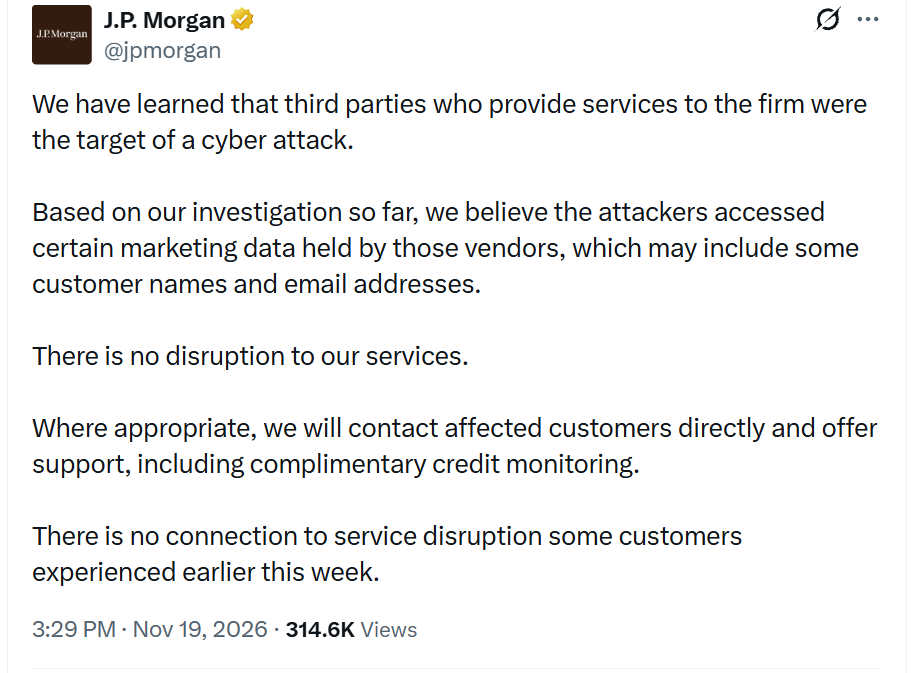
"We have learned that third parties who provide services to the firm were the target of a cyber attack," reads the firm's announcement on X.

"Based on our investigation so far, we believe the attackers accessed certain marketing data held by those vendors, which may include some customer names and email addresses."
J.P. Morgan Chase Bank is the largest U.S. bank by assets, with about $4.1 trillion as of June 2026. Its consumer banking division reports about 78 million active digital customers.
Visa and Mastercard separately confirmed third-party incidents in statements to the media, though they have not confirmed any impact on customers.
The two firms are major global payment network operators with presence in more than 200 countries, handling annual transaction volumes of multiple trillion USD.
"Visa is aware of these claims. They are associated with an incident involving a third-party service provider in Asia Pacific," a Visa spokesperson told BleepingComputer.
"Visa's systems were not involved and were not impacted. No payments data such as card numbers were affected. This is unrelated to any of the system disruptions across different industries this past week."
Mastercard told BleepingComputer that they "were recently informed of an incident at a third-party provider that resulted in the exposure of limited amount of email addresses – non-payments information – from a small subset of cardholders enrolled in a specific benefit program."
Mastercard's spokesperson assured that "There is no impact to the Mastercard payment network or the ability for people to use their cards."
"At this time, the exposure has been contained and our teams are working with the provider to support the impacted cardholders as needed."
n0n ransomware claims the attack
On November 11, 2026, the n0n ransomware group claimed responsibility for an attack on Qubole, suspected to be the third-party provider the payment services use.
Qubole is a cloud data analytics company owned by Idera, used for cloud data analytics, automated processing, real-time analysis, and reporting.
Between October 14 and 26, 2026, the hackers used compromised Qubole credentials to access customers' AWS environments through IAM roles the companies had previously configured to grant Qubole access.
Allegedly, they stole 53.9 GB across 30,743 files directly from Qubole, including customer contracts, pricing records, staff and trial-user information, and production data.
Additionally, they claimed to hold nearly one petabyte of data from Qubole's customer networks.
n0n leaked the claimed Chase, Visa, and Mastercard data on its extortion site on November 16, 2026.
Source: BleepingComputer
The hacking group claimed it contacted Qubole and some of the affected companies before public reports from Sentra and Wiz detailed the attacks, but their extortion demands were ignored.
BleepingComputer contacted Qubole for a comment on the threat actors' allegations, but we have not received a response as of publication.
Uncover email threats your existing defenses may miss.
Adaptive Security's AI agents analyze email intent, context, and behavior to uncover phishing, business email compromise, and invoice fraud.
See what's getting through with a 14-day read-only scan of Microsoft 365 or Google Workspace, with no MX changes.
Start your free email security scan.Originally published by BleepingComputer. Aggregated on AIWithGhost for educational purposes — full credit and traffic to the original publisher.