Truffle Security launches program to revoke 1.4 million live secrets
Truffle Security has launched the Secrets Revocation Program, a free initiative that helps API key issuers revoke 1.4 million publicly exposed secrets that remain valid. [...]
Truffle Security launches program to revoke 1.4 million live secrets
Bill Toulas
- November 5, 2026
- 03:15 PM
Truffle Security has launched the Secrets Revocation Program, a free initiative that helps API key issuers revoke 1.4 million publicly exposed secrets that remain valid.
Since 2022, the company has discovered secrets embedded in public repositories, packages, container images, datasets, and applications.
Earlier this year, Truffle Security reported that it had found 543,000 valid credentials leaked in public GitHub repositories.
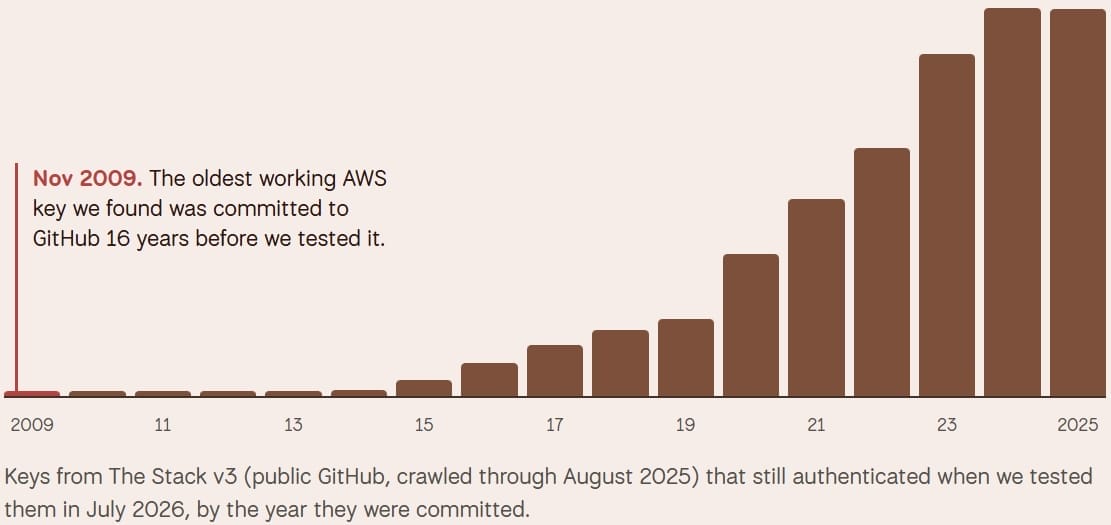
In a separate investigation, the company identified more than 431,000 AWS secrets across code repositories, Git histories, datasets, Docker images, registries, and CI logs.
These secrets are typically exposed by mistake during the development process, by committing credentials to a public repository, including them in published Docker images or packages, or leaving them in configuration files uploaded with an app or dataset.
Truffle Security says that the problem is that the owners of these secrets are not responsive to researchers’ notifications about leaked data.
“Telling developers their keys leaked doesn’t get them turned off: 81% of the keys we reported last year still worked six months later,” the company explained.
As a result, exposed secrets pose unnecessary security risks that can extend beyond the affected companies to their customers and downstream application users.
Source: Truffle Security
The researchers note that the rise of AI coding tools has only worsened the situation, increasing secrets exposure even more.
“Since January 2025 we’ve found 2,655 working keys in AI coding tools’ config files like that one,” the researchers said, noting that this was a non-existent problem the year before.
AI is also increasing the impact of exposure on the offensive side, as shown by OpenAI’s July incident, where AI agents used exposed Hugging Face tokens to steal data from the platform.
Revoking exposed keys
Truffle’s new program, which uses the TruffleHog tool to check for the validity of leaked keys, aims to coordinate the revocation of exposed secrets with the entities that issued them.
Truffle says it can either use a revocation endpoint provided by those entities, or supply them with the verified keys through a webhook and revoke them within 14 days.
This way, even when owners are unresponsive, the keys can be invalidated.
Source: Truffle Security
Sixteen issuers have already joined the program, including Hugging Face, Notion, Vercel, Resend, RubyGems, and Twilio.
Truffle says the unilateral revocation approach can be very effective, as demonstrated by Google when it began disabling exposed Google Cloud service-account keys by default on June 16, 2024.
When Google relied only on notifying key owners, Truffle Security found that many customers failed to respond, leaving 72% of the exposed secrets active. By automatically disabling leaked keys, the figure was reduced to 11%.
Although eliminating all valid exposed keys is impossible because customers can opt out of automatic revocation, the measure proved to be effective.
Companies that issue API keys can join Truffle Security's Secrets Revocation Program to automatically protect their customers.
Uncover email threats your existing defenses may miss.
Adaptive Security's AI agents analyze email intent, context, and behavior to uncover phishing, business email compromise, and invoice fraud.
See what's getting through with a 14-day read-only scan of Microsoft 365 or Google Workspace, with no MX changes.
Start your free email security scan.Originally published by BleepingComputer. Aggregated on AIWithGhost for educational purposes — full credit and traffic to the original publisher.