OAuth grants pile up faster than you can review them. Here's how to keep up.
OAuth grants create data highways between SaaS apps, AI agents, and other tools. And, they are multiplying faster than any security team can review them. As the recent Klue breach showed, attackers are taking notice and
OAuth grants pile up faster than you can review them. Here's how to keep up.
Nudge Security
- October 8, 2026
- 10:00 AM
Every time an employee clicks "Allow" on an OAuth consent screen, they create a standing trust relationship between two apps. An AI note-taker gets access to their calendar. A task management tool gets access to Slack. A new developer tool gets access to code repositories.
Each of those decisions takes seconds. Reviewing them properly takes much longer.
For IT and security teams, the question isn't whether employees will connect apps to corporate data. They already have, thousands of times over. The challenge now is keeping up: knowing which grants exist, which ones carry real risk, and which ones should be revoked, without spending your entire week on manual reviews.
That's exactly what Nudge Security does.
Why OAuth grants are so hard to govern
OAuth grants don't behave like the rest of your access. One common misunderstanding is assuming OAuth grants inherit the controls you've built around user identity. They don't. OAuth is a completely separate protocol from authentication. SSO governs how a user proves who they are. MFA adds friction to that proof. An OAuth grant is neither of those things.
They also outlast the credentials of the people who create them. Disabling a user in Google Workspace or Microsoft 365 only suspends grants that originated in that platform, but grants issued from third-party apps keep working uninterrupted.
Many grants sit dormant for months without producing a single log entry, but they stay fully valid and can be exercised at any time.
Attackers know this. In the recent Vercel breach, the root cause was a compromised OAuth token from Context.ai, a third-party AI tool that one employee had connected to their enterprise Google Workspace account months earlier. A single point of consent was enough to get in.
The numbers show why this keeps happening:
- 88 average OAuth grants created per employee, 31 of which carry data-level permissions (Nudge Security)
- 40 average apps per organization with programmatic access to sensitive corporate data (Nudge Security)
- 50% of SaaS breaches will stem from overprivileged OAuth tokens by 2027 (Gartner)
At a 1,000-person company, that's 88,000 access paths, and 31,000 of them have a direct line to sensitive data.
The OAuth grant lifecycle problem nobody is managing
OAuth grants outlive your employee credentials, operate outside of SSO, and move your data via pathways your network controls can't see.
Learn why they need their own lifecycle and access review process, and where to start.
Read the article →The math on manual reviews
A thorough review of a single OAuth grant looks something like this:
- Pull the app's profile. Has your security team already vetted it? Does the vendor have a real security and compliance program? Have they disclosed a breach in the last 12 months?
- Check the grantor's role to see whether admin rights were delegated to the app.
- Compare the requested scopes against what's typical for that kind of integration and against your own data-sharing policy.
- Reach out to the grantor to understand the business need, and check their MFA status.
Running through this process on a single grant can easily take 45 minutes to reach a verdict.
Forty-five minutes is a reasonable amount of time for one grant. It's an impossible amount of time for tens of thousands. No amount of expertise makes that manual work faster, and no security team has the headcount to keep up.
That's why agentic capabilities aren't a nice-to-have for managing OAuth grant risk. They're the only way to cover the attack surface you actually have.
Find every OAuth grant with Nudge Security
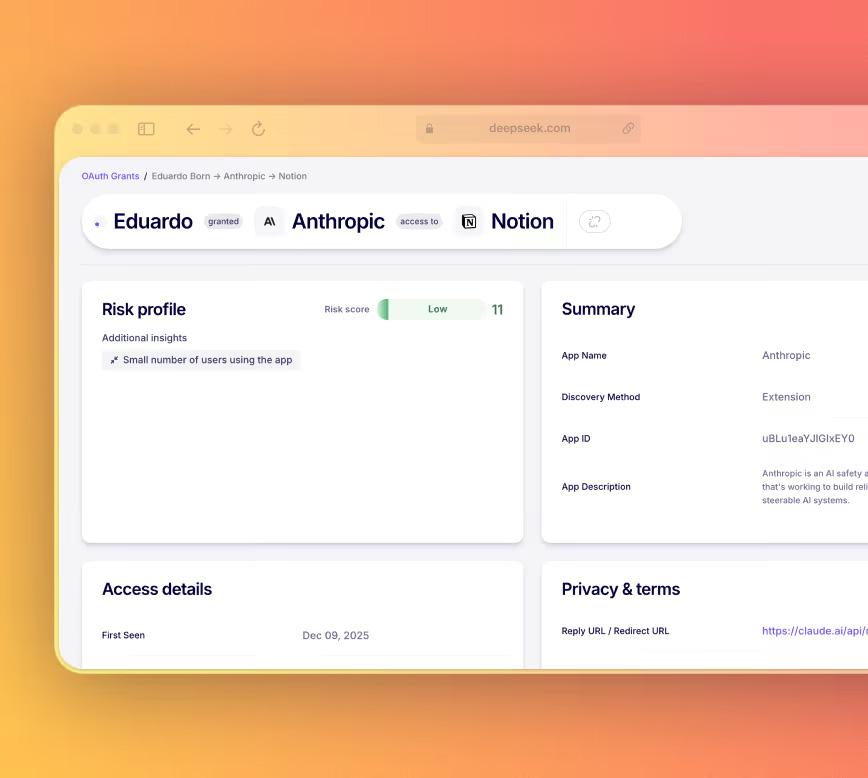
You can't assess a grant you don't know exists. Nudge Security gives you complete OAuth visibility into grants and app-to-app integrations across your SaaS estate from the start, including grants created long before you deployed Nudge.
Discovery doesn't depend on activity logs, so dormant and identity-only grants ("Sign in with Google") show up alongside the active ones. Nudge also surfaces API keys, service accounts, and remote MCP server connections powering AI tools and agents, giving you a full picture of programmatic access to your data.
For every grant, you can see:
- The app and vendor receiving access
- The employee who created the grant
- The exact permissions and scopes granted
- Which corporate apps and data the grant can reach
Assess: Surface the risk signals that matter
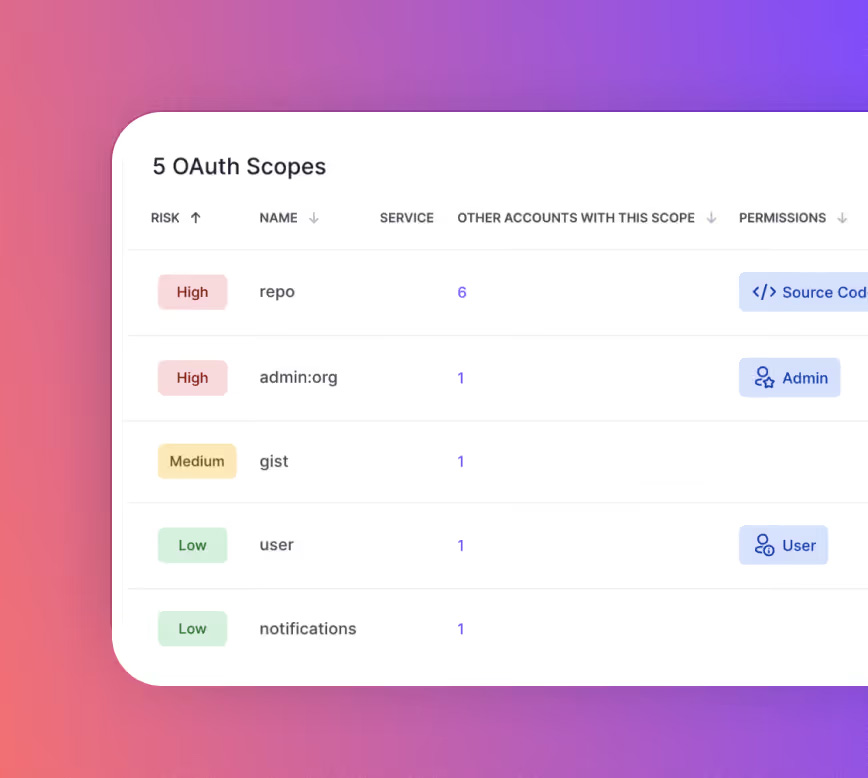
A list of grants is only useful if you know which ones to worry about. Nudge Security automatically classifies and risk-scores every integration based on the scope of permissions, the vendor, the grantor, org usage, and the sensitivity of the data being accessed.
Risk insights flag things like:
- Excessive or overprivileged permissions
- Suspicious domains
- Apps commonly used by threat actors for data exfiltration
- "Data highways," or connections with unusually broad, persistent access to sensitive data like email, files, and code repositories
- MCP servers acting as intermediaries between AI tools and your corporate data
Nudge also surfaces positive signals, such as popular apps and verified publishers, so you can quickly separate the routine from the unusual.
Analyze: Get a clear verdict on every grant in seconds
Risk scores tell you where to look. The OAuth Grant Risk Analyst agent does the actual analysis.
The agent reviews new OAuth grants as they appear, drawing on Nudge Security's discovery context across the browser, inbox, identity provider, and connected apps, plus risk intelligence from more than 240,000 vendor security profiles.
It evaluates the same factors an experienced analyst would:
- The grantor: who created the grant, their role, and their user metadata
- The vendor: security posture, compliance program, and recent breach history
- The permissions: which scopes were granted and how they compare to what's typical
- The reach: what the app can actually touch, and how it's used across your org
Because the agent looks at who created a grant, not just what the grant can do, it catches what a simple risk score misses, like a brand-new hire who created a high-risk developer grant.
Every analysis comes back with a plain-language risk evaluation, a TL;DR, detailed reasoning, any evidence gaps, and one of three verdicts:
- Permit: The grant is low risk and can stay in place.
- Justify: The grant needs further investigation. Review it with the person who created it to confirm the business need.
- Revoke: The risk outweighs the business value, and the grant should be removed.
That 45-minute review? The agent reached the same verdict in 15 seconds.
Govern: Your team makes the call
Speed is only valuable if you can trust the outcome. That's why the OAuth Grant Risk Analyst keeps your security team in the loop before anything changes.
The agent recommends the next step, and your team reviews the verdict and the evidence behind it. When you authorize an action, the agent orchestrates it, whether that's revoking the grant or nudging the grantor to justify the access. Every action is fully auditable, so you always know what was done, when, and why.
Beyond the agent, Nudge Security gives you the controls to keep OAuth risk in check over time:
- Nudge grantors directly through Slack, Teams, email, or the browser extension to request justification. Their responses are captured automatically.
- Get alerted to new OAuth activity as it happens.
- Revoke OAuth grants automatically when they're risky or unused, including as part of employee offboarding.
The result is a governed workflow that turns a 45-minute manual review into a decision your team can make in seconds, without handing over control.
The bottom line
Your employees will keep connecting apps to get their work done. That's not going away, and it shouldn't. Your job is to make sure every one of those connections is visible, understood, and revoked if the risk outweighs the value.
Nudge Security includes OAuth risk management as part of a comprehensive solution for SaaS and AI security governance. Nudge gives you a complete inventory of OAuth grants, the risk context to understand them, and an AI agent that delivers clear verdicts at scale, while your team stays in control of every decision.
Ready to get control of risky OAuth grants? Start a free 14-day trial.
Sponsored and written by Nudge Security.
Originally published by BleepingComputer. Aggregated on AIWithGhost for educational purposes — full credit and traffic to the original publisher.