Last Commit: Uncovering the Ghost in the Machine with Gemma
This is a submission for the Hacktoberfest Open-Source AI Challenge Week 4: Ghost in the Machine Last Commit — The Ghost in the Machine 👻 What I Built Last Commit is an AI-powered GitHub investigat
This is a submission for the Hacktoberfest Open-Source AI Challenge Week 4: Ghost in the Machine
Last Commit — The Ghost in the Machine 👻
What I Built
Last Commit is an AI-powered GitHub investigation platform that explores repositories, gathers evidence, interprets findings, and transforms them into structured reports.
Every GitHub repository has a story hidden inside it.
Behind every commit, file, code change, and development decision, there are traces of what happened. Understanding those traces manually can be complicated and time-consuming.
I wanted to build something that could uncover those stories.
Last Commit introduces an investigation pipeline built around three major stages:
- Evidence: Collecting relevant information from GitHub repositories.
- Interpretation: Analysing and connecting collected evidence to understand what is happening.
- Report: Transforming findings into a structured and readable output.
The platform integrates GitHub, route validation, an evidence ledger, output validation, and an AI-powered analysis layer.
Why Ghost in the Machine?
I interpreted the theme as exploring the hidden intelligence and forgotten traces that exist inside software systems.
A repository is more than a collection of files. It contains the history of human decisions, forgotten implementations, unexplained changes, and patterns waiting to be discovered.
I wanted the website itself to communicate this idea.
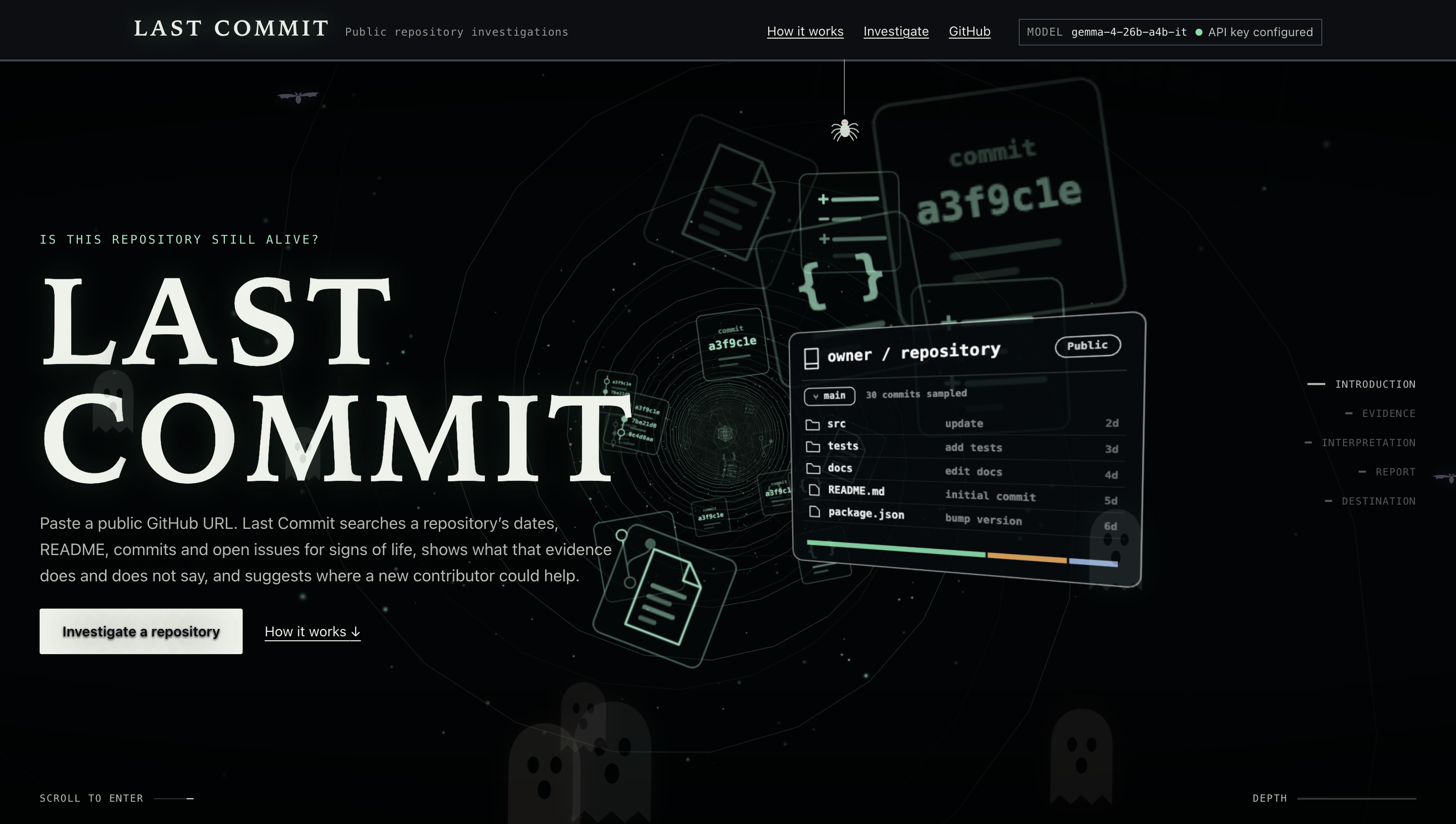
The experience begins with an immersive, continuously rotating 3D GitHub spiral. As users scroll deeper, they travel through a mysterious digital universe filled with floating repository cards, terminal windows, code fragments, ghostly entities, spider webs, and hacker-inspired visual elements.
The journey follows three central milestones:
EVIDENCE → INTERPRETATION → REPORT
The goal was to make repository investigation feel like exploring a mysterious digital world.
Demo
Live Website: https://last-commit-du3q.onrender.com
GitHub Repository: https://github.com/raj-x3/last-commit/tree/master
Explore the immersive interface and the GitHub investigation experience.
Code
GitHub Repository: https://github.com/raj-x3/last-commit
The project contains the frontend, backend, GitHub integration, AI integration, evidence processing, validation mechanisms, and reporting functionality.
How I Built It
I approached Last Commit as a full-stack application rather than simply building an AI chatbot.
The project combines:
- GitHub Integration: Retrieving repository-related information.
- AI Layer: Using Google's open-weight Gemma model to power the AI capabilities of the application.
- Evidence Ledger: Organising and tracking collected evidence.
- Route Validation: Validating investigation routes and workflow execution.
- Output Validation: Checking generated outputs before presenting results.
- Backend: Handling API requests and investigation workflows.
- Frontend: Providing an interactive interface and immersive 3D experience.
Why Gemma?
I integrated Gemma because I wanted to experiment with open-weight AI rather than make my entire project dependent on a closed proprietary model.
Gemma gives developers the flexibility to work with open model weights, experiment with different inference setups, and build AI applications with greater control over their AI layer.
For Last Commit, it powers the intelligence behind the investigation experience.
Why Does Open Innovation Matter?
Open innovation matters because the future of AI should not be limited to a handful of closed ecosystems.
As developers, we should have the freedom to experiment with models, understand their capabilities, customise implementations, and build applications around our own requirements.
Integrating Gemma into Last Commit gave me an opportunity to explore how open-weight AI can become part of a practical software development workflow.
It also makes experimentation more accessible to student developers and independent builders who want to create meaningful AI applications.
I believe innovation grows faster when developers can build upon shared technology rather than starting from zero or depending entirely on closed APIs.
My Agent Session
The DevRelay agent session is not included in this submission.
The Spirit of It
There is something fascinating about looking at a repository and realising that every commit tells a small part of a much bigger story.
Some changes are obvious. Others are buried deep inside files, dependencies, and development history.
I wanted to build an experience that captures that feeling.
The spiral represents going deeper into the machine.
The terminals represent its language.
The floating repositories represent its memories.
And the ghostly elements represent the traces left behind by everything that once happened inside it.
The machine remembers. Last Commit tries to understand what it remembers.
Prize Categories
- Best Use of Gemma
Team
Built with my teammate: Build alone by myself @rex_x3**
{% embed
 %}
Built with curiosity, experimentation, and open-source innovation.
devchallenge #hf26challenge #gemmachallange
Originally published by Dev.to WebDev. Aggregated on AIWithGhost for educational purposes — full credit and traffic to the original publisher.