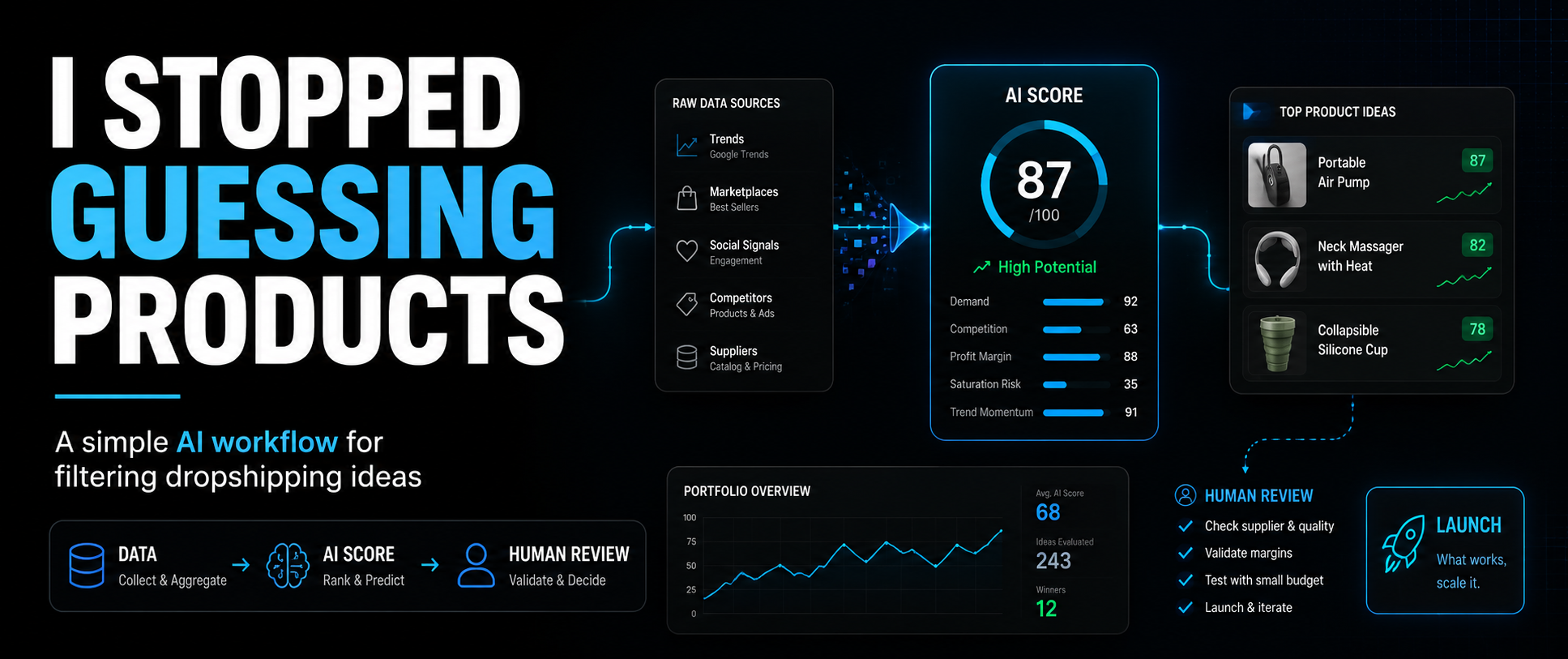
I Stopped Guessing Products: A Simple AI Workflow for Filtering Dropshipping Ideas
Most dropshipping product research still looks like this: Scroll through ads. Find a product that “looks l:contentReference[oaicite:0]{index=0}ces manually. Hope the product is not already saturated. The problem is n
Most dropshipping product research still looks like this:
- Scroll through ads.
- Find a product that “looks l:contentReference[oaicite:0]{index=0}ces manually.
- Hope the product is not already saturated.
The problem is not a lack of products.
The problem is that most people spend too much time researching weak ideas.
So I started thinking about product research as a filtering problem, not a “find the next winner” problem.
The workflow
Instead of asking AI:
“Find me a winning product.”
I give it a structured list of product candidates and ask it to score the risks.
For every product, I collect a few basic inputs:
- product name
- supplier price
- estimated selling price
- shipping time
- review count
- rating
- number of active competitors
- product category
- whether it solves a clear problem
Then the AI reviews the data and returns something much more useful than hype:
json
{
"product_score": 71,
"margin_score": 82,
"shipping_risk": "medium",
"competition_risk": "high",
"creative_potential": "strong",
"main_concerns": [
"Too many similar ads already running",
"Low margin after paid traffic",
"Long delivery time may increase refunds"
],
"decision": "test only with a differentiated angle"
}
What AI is actually good at here
AI is not magic product research.
It cannot reliably predict whether a product will go viral next week.
But it is very good at helping you eliminate bad options faster.
For example, it can flag products that have:
weak margins
unclear customer value
poor shipping conditions
too many direct competitors
no obvious content angle
high refund risk
That alone can save hours every week.
My basic scoring logic
I usually score each product across five areas:
Metric Question
Problem Does it solve something obvious?
Margin Is there enough room after ads and refunds?
Shipping Can customers receive it in a reasonable time?
Competition Is there still space for a new angle?
Content Can the product be demonstrated in 3 seconds?
The goal is not to find a perfect score.
The goal is to remove products that fail in multiple areas before spending money on ads.
The part that should stay human
I would not automate the final decision completely.
A product can look great in a spreadsheet and still fail because:
the landing page feels generic
the offer is weak
the creatives do not create curiosity
the audience does not trust the store
the product is hard to explain visually
AI can help you narrow the list.
But real validation still comes from testing the offer, creative, audience, and customer response.
My current rule
AI should not choose the product.
AI should help you reject bad products faster.
That shift changed how I look at automation.
Less “let AI run my store.”
More “let AI remove repetitive research so I can focus on better decisions.”
What part of product research would you automate first: product scoring, competitor analysis, supplier comparison, or ad creative research?
**Cover caption / subtitle:**
`AI-assisted product research for e-commerce: score faster, test smarter.`
Originally published by Dev.to AI. Aggregated on AIWithGhost for educational purposes — full credit and traffic to the original publisher.