How I Built an Ultra-Fast Automotive Diagnostic AI Agent with Sanity CMS and Groq LPUs
Automotive diagnosis is unforgiving. If a generic chatbot suggests the wrong spark plug thread pitch, an incorrect torque specification, or hallucinates an OBD-II code resolution, it can destroy an engine. Generic AI m

Automotive diagnosis is unforgiving. If a generic chatbot suggests the wrong spark plug thread pitch, an incorrect torque specification, or hallucinates an OBD-II code resolution, it can destroy an engine.
Generic AI models often give fluffy, non-committal advice. To solve this, I built AutoFix AI—an enterprise-grade automotive diagnostic assistant engineered specifically for automotive repair shops and technicians.
Here is how I architected the system combining Sanity Structured Data, Groq LPU ultra-fast inference, Next.js, and WhatsApp Cloud API to deliver sub-second, ASE Master Tech-grade diagnostics.
🛠️ The Architecture: Grounded AI vs. Hallucination
The biggest flaw in LLMs for specialized fields is hallucinated part numbers. AutoFix AI solves this through a deterministic grounding pipeline:
[User Query / WhatsApp / Web UI]
│
▼
[Next.js App Router API]
│
├────────► Sanity CMS Data Lake
│
▼
[Injected Context]
│
▼
Groq LPU Inference Engine
│
▼
[Structured Diagnostic Report + Parts Table + Torque Specs]
Code
1. The Knowledge Graph: Sanity CMS Structured Content
Instead of dumping raw vector embeddings, we use Sanity Headless CMS as a live structured relational store. Parts have strict schemas linking:
- Part numbers (OEM & Aftermarket)
- Vehicle compatibility arrays (
make,model,year) - Specifications (Thread diameter, reach, heat range, pre-gap)
When a query arrives, our backend dynamically queries Sanity via GROQ:
typescript
// Querying live catalog inventory context from Sanity Headless CMS
const parts = await sanityClient.fetch(
`*[_type in ["part", "product"]][0...8]{
title,
name,
partNumber,
category,
price,
"compatibility": compatibility[]{ make, model, year }
}`
);
This context is injected directly into the LLM system prompt, forcing the model to recommend verified parts currently registered in the database.
2. Sub-Second Inference with Groq LPUs
In an automotive shop, mechanics need instant answers. Traditional cloud LLMs take 3 to 8 seconds to respond.
By integrating Groq's Language Processing Units (LPUs) running the massive openai/gpt-oss-120b model, response latency drops to under 400ms.
Here is the core API handler:
TypeScript
// web/src/app/api/chat/route.ts
const groqResponse = await fetch('https://api.groq.com/openai/v1/chat/completions', {
method: 'POST',
headers: {
'Content-Type': 'application/json',
Authorization: `Bearer ${process.env.GROQ_API_KEY}`,
},
body: JSON.stringify({
model: 'openai/gpt-oss-120b',
messages: [
{
role: 'system',
content: `You are AutoFix AI Knowledge Agent, an expert Master Automotive Diagnostic Technician.
Guidelines:
1. OBD-II Diagnostics: Accurately diagnose trouble codes with severity ratings.
2. Verified Parts: Match OEM part numbers from Sanity context.
3. Actionable Estimates: Provide realistic labor hours and torque specs.
${sanityContext}`,
},
{ role: 'user', content: userMessage },
],
temperature: 0.2,
max_tokens: 1024,
}),
});
🧪 Putting It to the Test: Deep Diagnostic Scenarios
To prove the agent's depth beyond basic FAQs, we tested it with complex automotive edge cases:
Case 1: Complex CAN-Bus Breakdown
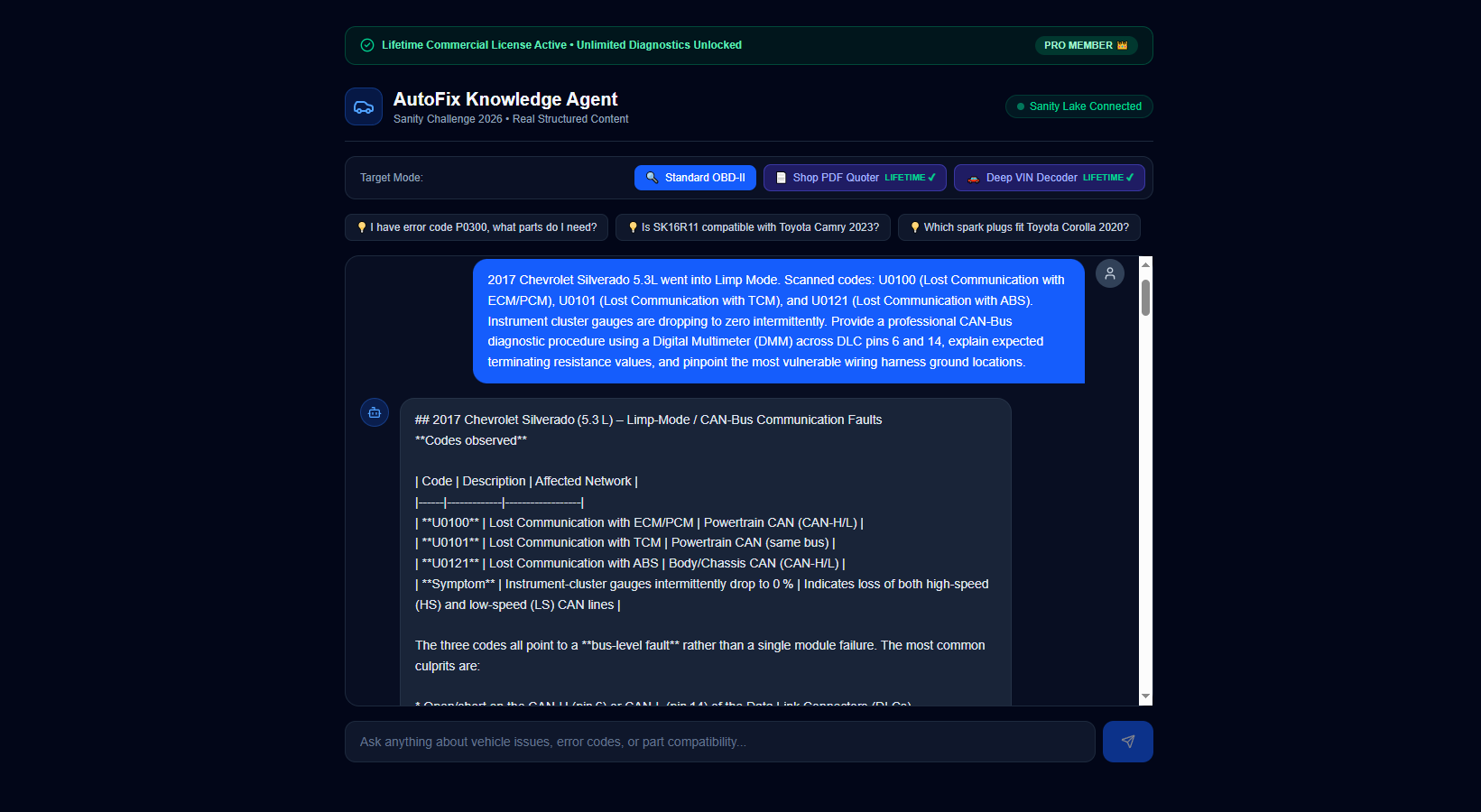
Prompt: 2017 Chevrolet Silverado 5.3L threw U0100, U0101, and U0121 with flickering gauges. Provide DMM pin 6 and 14 diagnostic steps.
AI Output: Rather than diagnosing isolated modules, the agent recognized a Bus-level failure. It accurately calculated the 60 Ω parallel terminating resistance across DLC pins 6 & 14 (two 120 Ω resistors in parallel) and provided exact wiring ground locations to inspect.
Case 2: Direct Injection Mechanical Coupling
Prompt: 2019 Ford F-150 3.5L EcoBoost with simultaneous P0016 and P0087.
AI Output: The model accurately deduced the physical connection: the High-Pressure Fuel Pump (HPFP) is driven by a roller-tappet on the intake camshaft. Timing chain elongation retard was correctly identified as the dual-culprit for both the cam timing mismatch and fuel pressure starvation under load.
📱 Multi-Channel Ready: WhatsApp Integration
AutoFix AI isn't limited to a desktop dashboard. We implemented a native Meta WhatsApp Cloud API Webhook inside Next.js (/api/webhook/whatsapp).
Mechanics working under a vehicle can snap a photo or message fault codes via WhatsApp and receive instant diagnostic reports directly on their phones.
🚀 Try It Live & Get the Source Code
🌐 Live Interactive Demo: sanity-autofix-agent.vercel.app
📦 Production Source Code & Commercial Widget: You can grab the complete turnkey codebase, Sanity schemas, and WhatsApp webhook integration on our store:
👉 Get AutoFix AI on Lemon Squeezy
What's Next?
We are expanding the agent to process raw oscilloscope .csv waveforms and OBD-II PID telemetry streams in real time.
What challenges have you faced when grounding LLMs in domain-specific technical fields? Let's discuss in the comments below!
Code
---
Originally published by Dev.to AI. Aggregated on AIWithGhost for educational purposes — full credit and traffic to the original publisher.