September 21, 2026
CompanyExpanding OpenAI Academy with new learning paths
Role-based learning helps employees, developers, leaders, educators, and students build practical AI skills and demonstrate what they’ve learned.
Using AI safely and effectively takes practice. People need to learn how to apply it to the work in front of them, whether they’re improving a daily workflow, building a product, leading a team, or teaching a class.
At OpenAI, we treat learning as part of deployment. Today, we’re expanding OpenAI Academy with new courses for developers, leaders, educators, and college students. These join Apply AI at Work, which helps people build foundational skills, create repeatable workflows, and direct work with agents.
Together, the pathways help organizations build shared habits for working with AI and develop the skills different roles require. Course assessments give learners a way to demonstrate what they’ve learned. Learners earn an OpenAI Academy course badge by passing the course assessment.
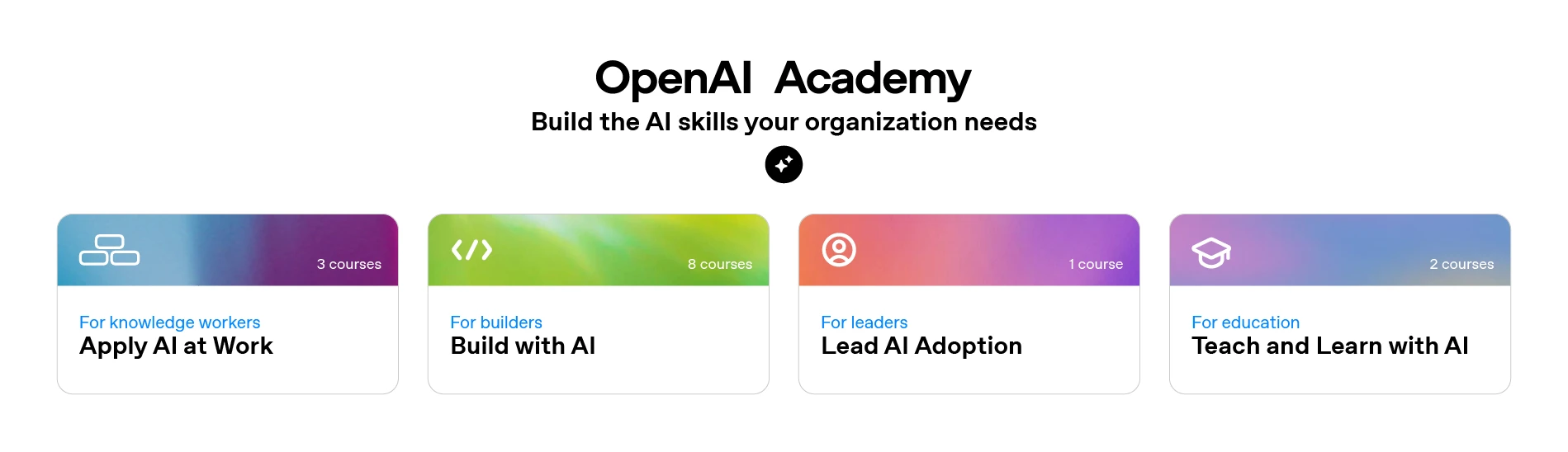
Choose a learning path for the work you do
OpenAI Academy (opens in a new window)courses are built around a simple idea: you should use AI to learn AI. Learners practice on real tasks, giving instructions, adding context, and reviewing results as they go.
Organizations can combine Apply AI at Work with focused learning for developers, leaders, educators, and students, choosing the courses that support their teams’ work.
Knowledge workers: Apply AI at Work
The Apply AI at Work(opens in a new window) pathway helps people use AI more effectively in their everyday work. Learners start with the basics, practicing how to give clear instructions, add relevant context, and review responses against the task at hand. They then turn successful approaches into workflows they can reuse.
As learners progress, they practice directing larger pieces of work with agents, deciding what to delegate and where to add checkpoints and human review. The pathway helps employees take on more complex tasks with AI while retaining responsibility for the final result.
Developers: Build with AI
The Build with AI(opens in a new window) pathway is designed for developers and technical teams using Codex or building products with the OpenAI API. For developers, the courses cover how to plan and implement changes across the software development lifecycle while maintaining control over review and quality. For teams building on the API, the pathway covers solution design, evaluations, agents, retrieving relevant information, and operating AI systems in production.
These courses are designed to help organizations move from experimentation to useful, reliable AI systems.
Leaders: Lead AI Adoption
Leaders must also decide where AI can create meaningful value, what the organization should prioritize, who owns the work, and how progress will be measured.
The AI Leadership(opens in a new window) course, part of Lead AI Adoption(opens in a new window), helps people responsible for strategy, adoption, and change management assess where AI could create business value. Learners connect an initiative to business priorities, define ownership and governance, and develop an initial AI strategy and roadmap for adoption.
Educators and students: Teach and Learn with AI
AI for Educators(opens in a new window) and AI for College Students(opens in a new window) extend the portfolio to teaching, learning, and career preparation.
In AI for Educators, learners use materials they have permission to use to plan a class, create an activity or assessment, or adapt communications for students, teaching assistants, or colleagues. They review ChatGPT’s responses against their learning objectives, source materials, and requirements. The educator decides what belongs in their teaching.
AI for College Students focuses on academic and career tasks. Students practice organizing readings and deadlines into a study plan, assigning roles in a group project, reviewing a draft against assignment requirements, and preparing for applications or interviews. They learn to bring the right materials into ChatGPT, strengthen their work, and make decisions about the final result.
Bring OpenAI Academy courses to your organization
Organizations can choose the learning paths that match their goals. A company might use Apply AI at Work in employee onboarding, offer Build with AI courses to developers and technical teams, and include AI Leadership in an executive, Champion, or transformation program. Education institutions can combine AI Foundations(opens in a new window) with AI for Educators and AI for College Students.
Learning is most useful when people have time to practice and apply it. Managers and Champions can encourage learners to bring real tasks into the courses, share useful examples, and connect what they learn to work already underway.
The OpenAI Academy Deployment Guide(opens in a new window) includes recommendations for introducing the courses, engaging leaders and managers, building participation, and tracking progress.
The courses are shaped by teams across OpenAI and will continue to be updated as our models, products, and guidance change.
Visit OpenAI Academy(opens in a new window) to explore the expanded course portfolio and find the right learning paths for your teams.