DeepInfer Is a Layer-2 Engine, Not Something You Install on Your Laptop
Every time a lab drops its production stack on GitHub, my group chat runs the same script. Someone posts the link, someone else works out per-GPU revenue, and by midnight three people are asking whether it will run on th

Every time a lab drops its production stack on GitHub, my group chat runs the same script. Someone posts the link, someone else works out per-GPU revenue, and by midnight three people are asking whether it will run on the machine under their desk.
That is what happened on October 20, when DeepSeek open-sourced DeepInfer under Apache 2.0 together with a Rust tokenizer component called deepseek-recipe. The thread hit the front page of Hacker News fast, and trend boards such as AIHOT pushed it to the top as well. A trend board only measures how loud the discussion is. It is not evidence of anything.
The number that spread through developer groups was 155 trillion tokens of daily throughput, which some people turned into about $38 of book revenue per GPU per hour, and from there into a claim that second and third tier compute vendors could clear gross margins above 90% by running this code in their own data centers. Engineers who work on low level infrastructure pushed back on that quickly. Book revenue from one inference run and net profit after training costs, R&D headcount, electricity and GPU depreciation are different quantities, and a number produced in a comment thread at extreme throughput is a modeling assumption, not an audit.
I am not going to redo that arithmetic. The question I actually care about is simpler. The code is free, so can I pull it down and run a full power DeepSeek service on my own hardware tonight?
The short answer I now give people is a category correction. DeepInfer is not a desktop app and not a model switcher. It is the engine core that runs inside a data center and keeps GPUs busy. Everything needed to turn that engine into a service other people can call sits above it, and none of it is in the repository.
What DeepInfer actually is, in three parts
Open the repo and the first screen is operators, communication overlap and scheduling scripts. It is built for extremely large Mixture-of-Experts models and Multi-head Latent Attention. It started from vLLM, and the vLLM team published a post thanking the DeepSeek engineers for the work. Three pieces were released on October 20.
The engine that keeps GPUs from idling
Teams that pulled open weights and ran them themselves often watched utilization drop in and out. DeepInfer uses asynchronous pipeline overlap between GPU and CPU to keep compute units from sitting idle, and it applies variable-length verification to speculative decoding, which adds another 6% throughput in production.
Cache scheduling built for long context
Agent traffic and long conversations re-run prefill over and over, and each repeat is paid for. The sliding window attention bounded replay technique skips the disk write for sliding window caches with minute level lifetimes and recomputes only the last 128 tokens each time, which cuts prefill computation in half.
deepseek-recipe, the Rust sidecar
This one handles protocol clashes and tokenization stalls. It normalizes OpenAI Chat Completions, OpenAI Responses and Anthropic Messages into a single internal representation, uses segmented parallel encoding so long text tokenizes faster, and blocks special token injection at the lowest level.
Read those three together and the shape is clear. This is industrial plumbing for a machine room, not a chat app.
The four layers between a repo and a service I can call
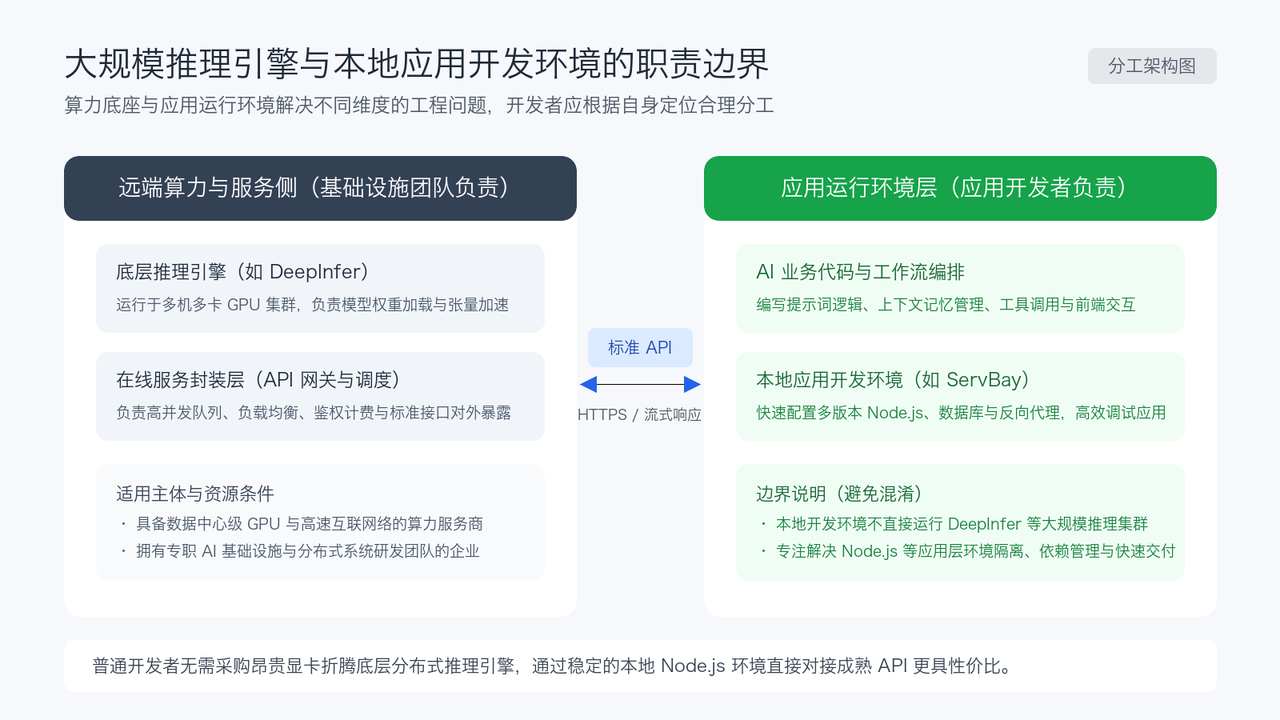
The confusion starts when people treat open weights, an inference engine, an online service and an application runtime as one thing. Split the delivery chain and the picture stops being mysterious.
Layer 1, the weights
A few hundred GB of parameter files. They decide how good the model is, and on a hard drive they are static data. They do not answer anything by themselves.
Layer 2, the inference engine
This is where DeepInfer and deepseek-recipe live. The job is to move weights into VRAM and schedule hundreds or thousands of cards through matrix multiplication, faster and with less power draw. It executes compute and converts protocols. It does not run a business.
Layer 3, the online serving layer
Registration, API key authentication, balance billing, concurrency rate limiting, queueing at peak, failover when a card dies, monitoring alerts. None of these modules are in the repository. A team that wants to sell access builds all of it themselves.
Layer 4, the application runtime
This is where business code lives. Node.js, Python, a database, prompt workflows, front end pages, and an HTTPS request to whatever endpoint layer 3 exposes. This is the layer most of us actually work on.

What the project released is the engine core of layer 2. What many developers expect is a finished car with fuel in the tank and the keys in the ignition.
The hardware bar, checked against the October 20 docs
I am staying inside what the official documentation says here. No installation tutorial, and no invented benchmark numbers, because I do not have the hardware to produce either.
Eight GPUs for prefill, 64 to 128 for decode
The design is prefill and decode disaggregated from the start. Ordinary 8 GPU machines handle prefill of the input. When it reaches decode, generating the answer token by token, the balance between throughput and latency pushes it onto 64 to 128 card supernodes. That card count alone rules out workstations and the single machine servers small teams keep in a rack.
100 PiB of 3FS and RDMA reads at 10 TiB per second
To hold KV cache for agent traffic beyond 72 hours and cache chat traffic for a full 7 days, the team built a 100 PiB 3FS distributed storage cluster. Disks are not enough on their own. RDMA network cards and GDR technology push aggregate read bandwidth to 10 TiB per second and overlap the cache swap from disk into VRAM with forward computation, so GPU compute units stay free. Home cabling or the ordinary internal network between cloud hosts will not carry that swap pattern.
The cheap single GPU line that gets misread
The docs say a certain component usually needs only one card and recommend using the cheapest card in range. What that refers to is the Vision Encoder, one small local module. Main model inference still runs on the cluster described above.
What the repo does not ship
There is no double click desktop GUI in the style of Ollama or LM Studio. There is also no multi tenant gateway, billing, rate limiting or circuit breaking. DeepInfer gives compute vendors, cloud providers and infrastructure teams with their own data centers a production recipe that closes a commercial loop. It is not an installer for a personal machine.
The checklist I run before cloning any inference repo
One minute with the table below saves an evening of compiling.

Four checks
| Verification dimension | Hard requirement for self-hosting an engine like DeepInfer | Real situation for an application developer | What I do |
|---|---|---|---|
| GPU and machine scale | 8-GPU nodes for Prefill, 64 to 128-GPU supernodes for Decode | A Mac, an ordinary PC, or a single consumer-grade GPU | Outside the supported range, so skip the local build |
| Network and storage infrastructure | RDMA NICs, GDR direct reads, large-scale distributed storage pools | Ordinary public bandwidth or standard cloud host disks | No reason to rent bare-metal supernodes for a low-level framework |
| Completeness of surrounding services | An inference kernel and protocol conversion only, no gateway, authentication, billing, or monitoring | Needs a stable HTTPS endpoint available at any time | Call the official API or a compute provider running DeepInfer |
| Focus of daily work | CUDA operators, cluster communication overlap, VRAM fragmentation | Shipping features, tuning prompts, writing front-end and back-end interaction code | Leave compute in the data center, work at layer four |
The part that follows from vendors adopting DeepInfer is good for the rest of us. Inference cost comes down, token prices fall, response times improve. That is a win for people writing application code, even if they never touch a cluster.
Where I moved the lightweight work
The change in my own practice was to stop asking one layer to do everything. Heavy compute stays in a data center that was built for it. The small decisions that come up every day, such as which Node.js version a project needs, whether the local database is running, whether there is an HTTPS domain for debugging, belong to tooling on my own machine. Those are not model problems and they do not deserve a GPU.
The friction is real. One project needs Node.js 20, an older repo needs Node.js 16, and there is still a local database and an HTTPS domain to set up before anything can be tested. Half a day can disappear into dependency wrangling before a single line of business logic is written.
The layer-four tooling I use
For that layer I use ServBay, an AI development management tool that runs on my machine. It brings up a clean Node.js runtime with isolated versions in one click, and keeps Node.js, database and web service configuration in order instead of scattered across shell profiles. I want the boundary to be clear here. ServBay works at layer four. It is not a way to install a DeepInfer cluster on a laptop, and it is not trying to be.
The code
With a local Node.js runtime running steadily, the remote cluster does the heavy lifting and a few dozen lines of standard JavaScript pull DeepSeek output into the app.
// Calling the DeepSeek-compatible API from a local Node.js runtime
// Prerequisite: Node.js 18 or above enabled locally via ServBay
async function askDeepSeek(question) {
const apiKey = process.env.DEEPSEEK_API_KEY;
const url = 'https://api.deepseek.com/v1/chat/completions';
const response = await fetch(url, {
method: 'POST',
headers: {
'Content-Type': 'application/json',
'Authorization': `Bearer ${apiKey}`
},
body: JSON.stringify({
model: 'deepseek-chat',
messages: [
{ role: 'system', content: 'Answer technical questions concisely.' },
{ role: 'user', content: question }
],
temperature: 0.3
})
});
if (!response.ok) {
throw new Error(`Request failed with status code ${response.status}`);
}
const result = await response.json();
return result.choices[0].message.content;
}
FAQ
The docs recommend deploying on one cheap GPU, so why do you say it will not run on a personal computer?
That sentence covers the Vision Encoder sub-module inside the multimodal component. Main model inference still uses 8 GPU machines for prefill and 64 to 128 GPU supernodes for decode, and it depends on RDMA networking and large scale distributed storage. A desktop or a single gaming card is not in the deployment scope.
How is this different from Ollama or LM Studio?
Different level of the stack. Ollama and LM Studio are lightweight tools for personal computers, built around a graphical interface and quantized, compressed small models. DeepInfer is a distributed inference engine for data center clusters, built to push full weight models through multi machine, multi GPU environments. There is no personal desktop installer.
Can deepseek-recipe be used as a complete commercial API gateway?
Not on its own. It is a high performance tokenizer and protocol conversion component in Rust. It turns OpenAI and Anthropic style requests into one internal format and blocks special character injection. User registration, API key balance deduction, multi tenant billing statements and cluster monitoring are not part of it.
What is the least painful path for an application developer?
Skip the local install of a distributed engine. Get a stable application development environment running on your own machine first, for example by following the ServBay Node.js documentation to bring up Node.js and the database you need, then call the official API or a compliant compute provider over HTTPS and spend the saved time on business logic and product polish.
What I take away
Read the layer, not the headline
DeepInfer's technical value stands on its own. Compute providers around the world now have a cost saving recipe validated by hundreds of billions of requests worth of traffic. Its home is 8 GPU nodes, 128 card supernodes and RDMA networks, not a desk.
The division of labor is the point
Vendors run DeepInfer and push token prices down. Application developers keep layer four tidy and turn cheap, usable AI interfaces into products that earn money. Getting that split right is cheaper than buying GPUs to prove a point.
Originally published by Dev.to AI. Aggregated on AIWithGhost for educational purposes — full credit and traffic to the original publisher.